Virtual Cell Challenge 2025 Wrap-Up: Winners and Reflections
Top three scoring models named along with an additional “Generalist Prize”

1. The First Virtual Cell Challenge
Thank you to every participant who made the inaugural Virtual Cell Challenge a success. The response far exceeded our expectations: over 5,000 people registered across 114 countries, over 1,200 teams submitted results, and over 300 teams made final submissions. We saw remarkable diversity, from students learning the field to established research organizations.
We have an ambitious goal of predicting cellular response to perturbation, a challenging and impactful task with wide implications for biology. While the final results of this first effort indicate that perturbation prediction models are not yet consistently outperforming naive baselines across all metrics, we saw significant improvements on core capabilities like perturbation discrimination and identification of differentially expressed genes. The winning approaches combined deep learning with classical statistical features, suggesting pure end-to-end learning is yet to solve this problem. But this is exactly why the Virtual Cell Challenge is needed. There’s much more to do beyond these first steps to close the gap between current models and biological fidelity.
2. Why We Hosted This Challenge
About 90% of drugs fail clinical trials due to poor efficacy or unintended side effects. Each drug tested in the lab or in patients is essentially a probe designed to perturb diseased cells in a particular way. A highly predictive virtual cell model could help researchers discover new drugs, entirely in silico, capable of shifting cells between states: from “diseased” to “healthy”, with fewer off-target effects, potentially transforming clinical success rates and speeding the pipeline from lab to patient.
Virtual cells could also serve as hypothesis-generating engines for biology, analogous to how AlphaFold has transformed protein structure prediction. Rather than running expensive, time-consuming experiments for every hypothesis, researchers could screen thousands of perturbations in silico, then validate the most promising candidates experimentally.
The Turing Test for Virtual Cells
We designed the Virtual Cell Challenge around this concrete question: can a computational model stand in for an actual Perturb-seq experiment? If you give a model a starting cell state and a genetic perturbation, can it predict the resulting gene expression changes well enough to guide biological discovery?
This is ultimately our North Star: not whether models achieve high scores on abstract metrics, but whether they capture biology accurately enough to be useful. What brought forth the AlphaFold moment in protein structure prediction was less about beating specific benchmarks, but more about passing the practical usability threshold for biologists.
3. Dataset Design: Building a True Benchmark
As detailed before, we generated a purpose-built benchmark dataset of ~300,000 single-cell RNA-seq profiles from H1 human embryonic stem cells with 300 CRISPRi perturbations. In our Virtual Cell Challenge commentary, we explained our key design choices:
- H1 hESCs represent a distributional shift from typical training data (K562, A375, and cell lines in other large-scale datasets like Tahoe-100M), forcing models to generalize rather than memorize
- CRISPRi perturbations provide clean transcriptional repression with directly observable knockdown efficacy
- High-quality data: 10x Genomics Flex chemistry, >50,000 UMIs per cell, ~1,000 cells per perturbation
The 300 target genes were carefully selected to span from dramatic to subtle transcriptional effects, ensuring comprehensive evaluation of model capabilities (see Behind the Data of the Virtual Cell Challenge).
4. Three Metrics, An Unexpected Challenge, and An Expanded Prize
We designed three evaluation metrics to capture different aspects of perturbation prediction:
PDS (Perturbation Discrimination Score): Measures whether predicted perturbation effects remain distinguishable from each other. Uses L1 norm to rank whether each prediction is closest to its true counterpart.
DES (Differential Expression Score): Evaluates whether models identify the correct set of upregulated and downregulated genes. Middle ground between ML optimization and true experimental measurements. In practice, biologists often view the set of differentially expressed genes as the most relevant output from Perturb-seq experiments.
MAE (Mean Absolute Error): Quantifies gene-level prediction accuracy across the entire transcriptome. Requires faithful prediction of experimental measurements across all genes. While the previous two metrics were motivated by biological considerations, they are not exhaustive in capturing cell state, so MAE was designed to be maximally expressive and capture aspects that the other metrics may miss. However, this comes with tradeoffs: much of the signal in raw counts is influenced by technical noise, stochastic dropout, and biological heterogeneity. As a result, although the absolute value of MAE may be very difficult to lower beyond simply predicting the average cell state, it remains useful in relative terms for detecting when solutions deviate substantially from values typically observed in experiments.
Almost all models performed worse than baseline on MAE. While not entirely unexpected, this effectively excluded MAE from competitive optimization, meaning top performers strategically focused their efforts on PDS and DES.
The Generalist Prize: Expanding Evaluation
As the competition progressed, we observed that MAE was no longer influencing the leaderboard since submissions were not penalized for scoring worse than the mean. We didn’t think it would be fair to participants to drastically alter the scoring framework mid-competition, so instead we introduced a new prize category based on a broader evaluation. The Generalist Prize used seven metrics total:
-
The three Challenge metrics: DES, PDS, MAE
-
Four additional metrics that were used to measure the effectiveness of our State model: Pearson delta correlation, Spearman correlation of log-fold change, area under precision-recall curve (AUPRC), and Spearman correlation of effect size. These and the three Challenge metrics are all in our Cell-Eval suite of model evaluation metrics.
We took the entries with the highest leaderboard scores on the Challenge metrics and ranked them on each of these seven metrics, and the winner had the highest average ranking across all seven, demonstrating consistent performance across diverse criteria rather than optimization for any specific target metric. We are releasing the top 25 ranked teams from this analysis on a separate leaderboard.
PDS Behaviors
The Challenge community generated lots of interesting commentary and analyses as the competition unfolded. One of the participating teams published an analysis revealing that L1-based PDS is inherently scale-sensitive. As models increase prediction magnitude, PDS scores rise, asymptotically approaching sign-based cosine similarity. This isn't a bug per se but does reflect high-dimensional geometry. Top teams recognized that PDS primarily rewards getting expression patterns correct rather than exact magnitudes. However, understanding metric properties alone wasn't enough; teams still needed to capture real biological signals to succeed on DES and achieve top leaderboard positions.
5. Winners
We are very pleased to congratulate the following teams:
🥇 First Place - $100,000: Team BM_xTVC
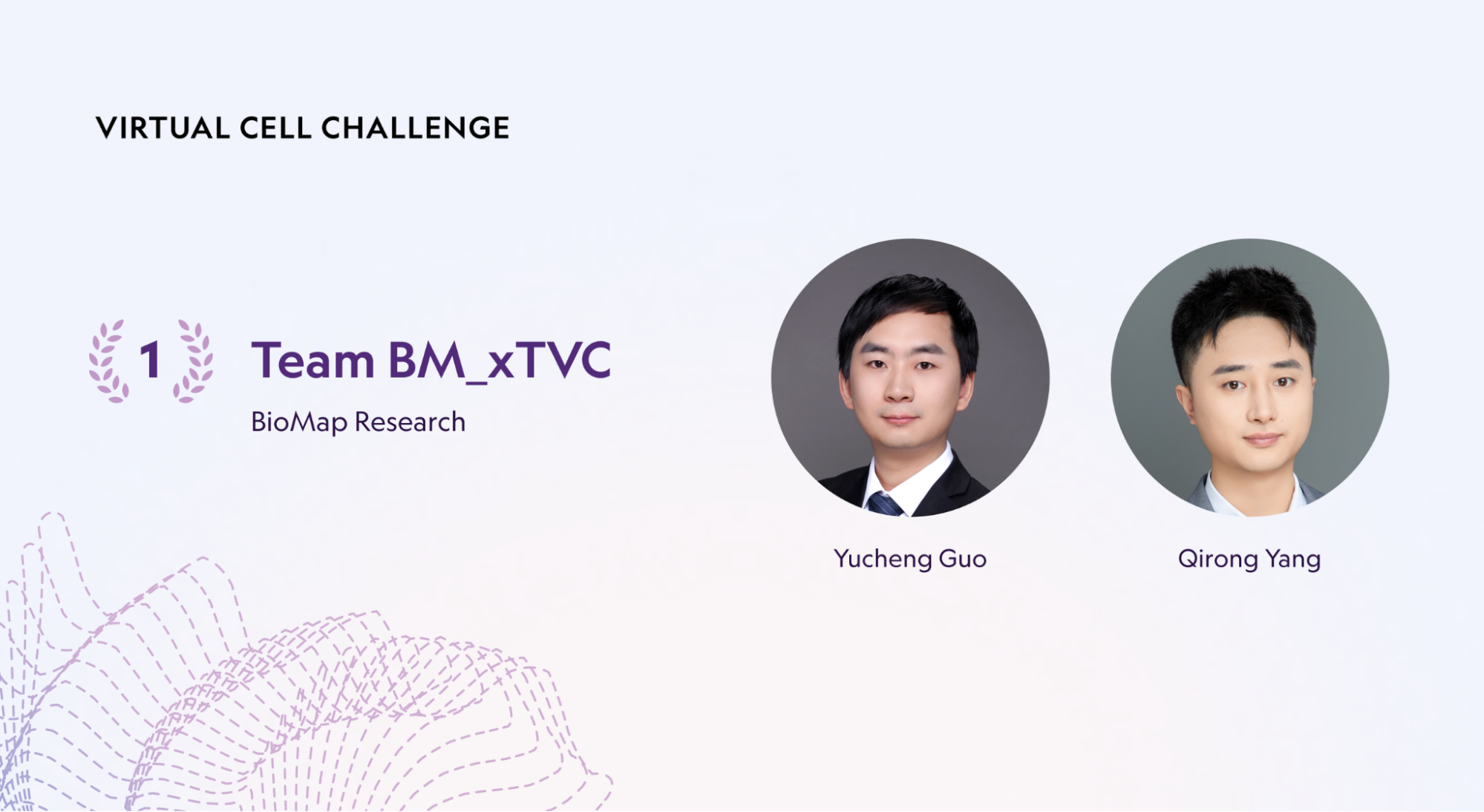
Members: Yucheng Guo, Qirong Yang
Organization: BioMap Research
Model: xTrimoSCPerturb
Team BM_xTVC built a sophisticated hybrid approach combining deep learning with classical statistics. They developed a new single-cell pretrained model using an improved scFoundation architecture, then integrated it with protein model embeddings and carefully curated public perturbation datasets.
Their approach addressed fundamental architectural limitations–specifically the poor capture of gene sequential relationships and inadequate representation of biologically expressed genes prone to technical dropout. By optimizing the encoder to recover biologically active signals from technical zeros and employing a disentangled cross-attention decoder architecture, they achieved high-fidelity cell embeddings and precise gene regulation predictions. For perturbation training, this team had selected a subset of the public perturbation datasets listed on the challenge website. A critical insight from their work: "Purely AI-based approaches did not consistently outperform statistical baselines" on DES and MAE. Rather than fight this, they incorporated training-set DEG frequency and mean expression levels as explicit features. Their final model used a fused loss function (PDS + DES + small-weight MAE) and trained on pseudo-bulk RNA-seq data, repeating outputs multiple times to satisfy DES evaluation requirements.
BioMap Research, where Team BM_xTVC is based, plans to share full theoretical details and methodological innovations in a forthcoming academic paper.
🥈 Second Place - $50,000: Team XLearning Lab

Member: Xi Peng
Organization: School of Computer Science, Sichuan
University, Tianfu Jincheng Lab
Model: X
This entry took an explicitly metric-driven approach, recognizing that PDS carried roughly twice the weight of DES in final scoring. They framed the problem as conditional generation and shifted from noisy single-cell to pseudo-bulk data representation.
The architecture was streamlined: a Fully Connected Network using aggregated control expression, ESM-2 protein embeddings for perturbed genes, and UMI count indicators. Residual learning predicted perturbation deltas rather than absolute values, optimized with MSE loss and auxiliary objectives. For training, they exclusively used publicly available Perturb-seq datasets, including a small H1 dataset available as part of PerturbAtlas.
Team member Xi Peng’s research group, which includes fellow Virtual Cell Challenge competitors Yunfan Li and Yiding Lu, focuses on machine learning and its interdisciplinary applications in life sciences.
🥉 Third Place - $25,000: Team Outlier

Members: Qiyuan Liu, Qirui Zhang,
Jin-Hong Du,
Siming Zhao,
Jingshu Wang
Organizations: University of
Chicago, Dartmouth College, University of Hong Kong
Model: TransPert
Team Outlier’s model, TransPert, is a statistical framework for cross-cell-line perturbation prediction using only summary-level data, namely pseudo-bulk perturbation profiles and the differential testing results from the Wilcoxon test.
The framework combines gene-level perturbation summaries from multiple reference cell lines using similarity-aware aggregation, then refines these estimates by predicting which genes are likely to be significantly affected in the target cell line. Finally, global linear scaling optimizes the predictions for PDS metric performance, with scaling factors selected via cross-validation on Challenge training data. For training, Team Outlier exclusively used publicly available cell line Perturb-seq datasets.
As discussed in their recent Arxiv commentary “Effects of Distance Metrics and Scaling on the Perturbation Discrimination Score”, such scaling makes the predictions behave more like a weighted sign-cosine-similarity-based score, improving discriminative power. A full methodological description of TransPert will also be provided in a forthcoming manuscript.
Team Outlier brought together researchers from three institutions with expertise spanning statistics, machine learning, and genomics.
🏆 Generalist Prize - $100,000: Team Altos Labs
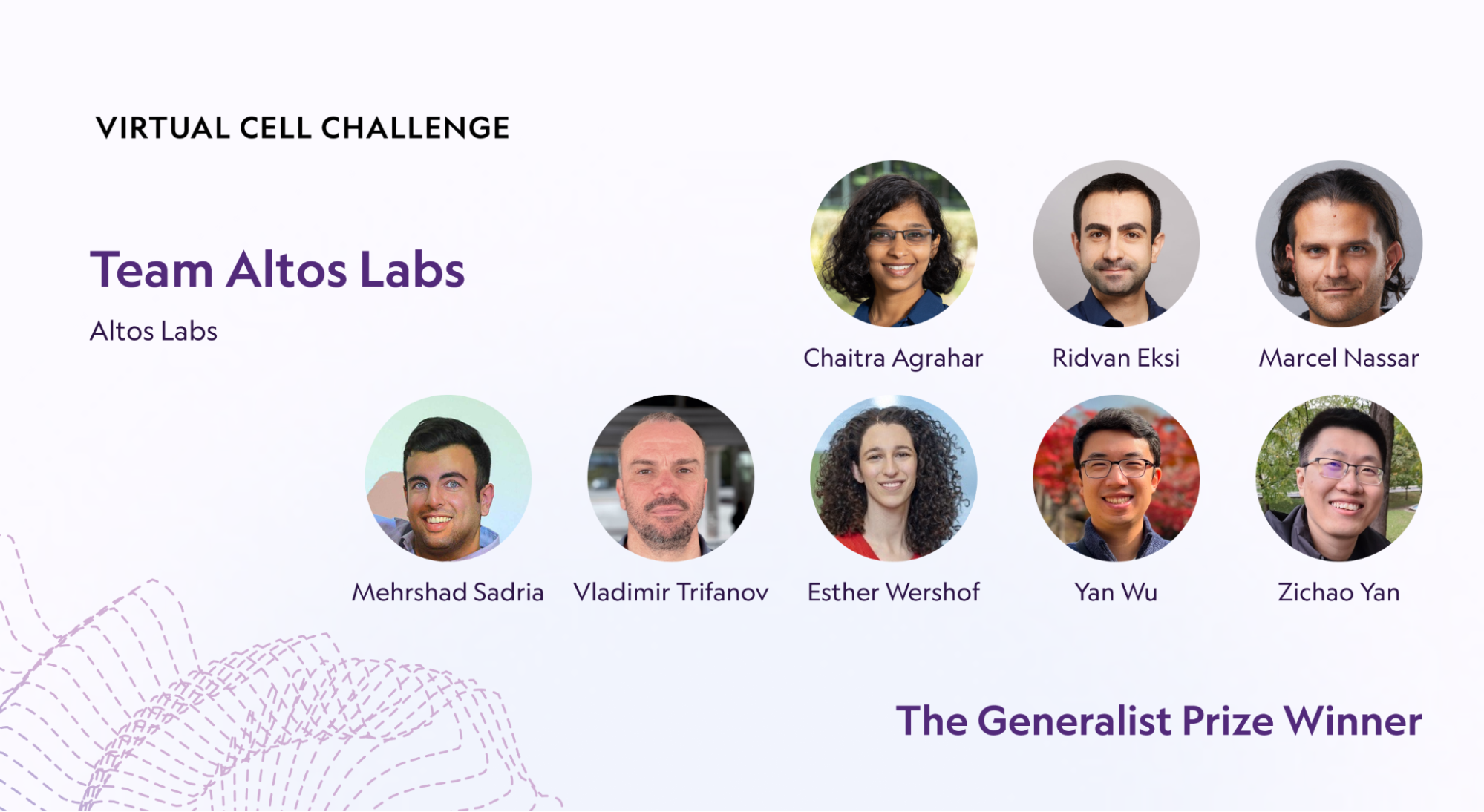
Members: Chaitra Agrahar, Ridvan Eksi, Marcel Nassar, Mehrshad Sadria,
Vladimir Trifonov, Esther Wershof, Yan Wu, Zichao Yan
Organizations:
Altos Labs
Model: go-with-the-flow
The Altos Labs team achieved the highest average ranking across seven metrics (three challenge metrics plus four metrics from the State paper) among the 50 final entries with the highest scores on the challenge metrics, demonstrating robust performance rather than optimization for any single target. They showed the most reliable generalization across diverse evaluation criteria, so we are awarding them the Generalist Prize to recognize this result.
The team developed a flow matching generative model to infer heterogeneous cellular responses to perturbations. Operating directly in the gene expression space, the model learns time-dependent dynamics, parameterized through a customized U-Net architecture, to update the gene expression vectors. This approach enabled the team to capture fine-grained gene expression details including complex gene-gene interactions.
They pretrained their flow matching model on approximately 7 million high-quality single cells combined from various public data sources, including the Challenge training data, and Altos Labs' internal perturbation screens (none in H1 cells). They then fine-tuned their model on a smaller dataset specifically targeting the h1ESC cell line and perturbations in the Challenge test sets.
The team members are from the Altos Labs Institute of Computation, whose mission is to pioneer advances in computation and machine learning to solve some of the most fundamental challenges in biological research and medicine. Altos pursues fundamental basic research in the biology of aging and rejuvenation.
6. What We Learned and Where We're Going
Key Insights
The Challenge revealed important patterns in winning approaches: hybrid models combining deep learning with statistical features outperformed pure neural networks, and strategic loss function design mattered as much as architecture. Multi-modal features, particularly protein embeddings, added value across top teams. The evaluation sparked valuable discussion about metric design. No single metric captures “model quality”, and we observed clear trade-offs where optimizing one metric sometimes came at the cost of others. We are studying this year's submissions to inform future metric refinements, potentially including norm-matched PDS variants and new biological relevance criteria.
The Challenge attracted two somewhat distinct communities that we are hoping to bring together for the benefit of understanding biology and disease. Machine learning specialists excelled at systematically optimizing models to improve metric performance. Computational biologists, on the other hand, brought a deeper understanding of functional genomics and perturbation biology. We hope that an optimally designed version of this Challenge in future years will make both perspectives essential and interdependent.
Looking Ahead
The first Virtual Cell Challenge is complete, but this is just the beginning. We look forward to running the Challenge as an annual competition, at the same time we ourselves are in the early stages of building models that can genuinely accelerate biological discovery—from hypothesis to experiment to treatment.
Get Involved:
- Sign up for Arc Institute updates to be notified when Virtual Cell Challenge 2026 opens
- Apply for a machine learning role at Arc
- Explore State and build your own models
- Contribute to our open datasets: Virtual Cell Atlas
7. Acknowledgments
To Our Participants: Thank you for exceeding our expectations. Your creativity, excitement, and scientific discussions have established a foundation that will shape virtual cell modeling for years to come.
To Our Winners: Congratulations on exceptional work. Your innovations, from hybrid statistical-ML approaches to rigorous metric analysis, will influence how the field approaches these problems. Thank you for sharing your insights openly.
To Our Sponsors: This challenge was made possible by NVIDIA, 10x Genomics, and Ultima Genomics. Their support enabled us to offer substantial prizes and generate the high-quality datasets that made rigorous evaluation possible.
To The Community: Your thoughtful engagement with metric design questions and evaluation frameworks is already shaping next year's Challenge. The collaborative spirit made this more than a competition; together we're building the future of predictive cell biology.
Special thanks to the Arc Institute team and everyone who contributed to making the inaugural Virtual Cell Challenge a success.