John Pluvinage on a new vitamin B12 transport disorder
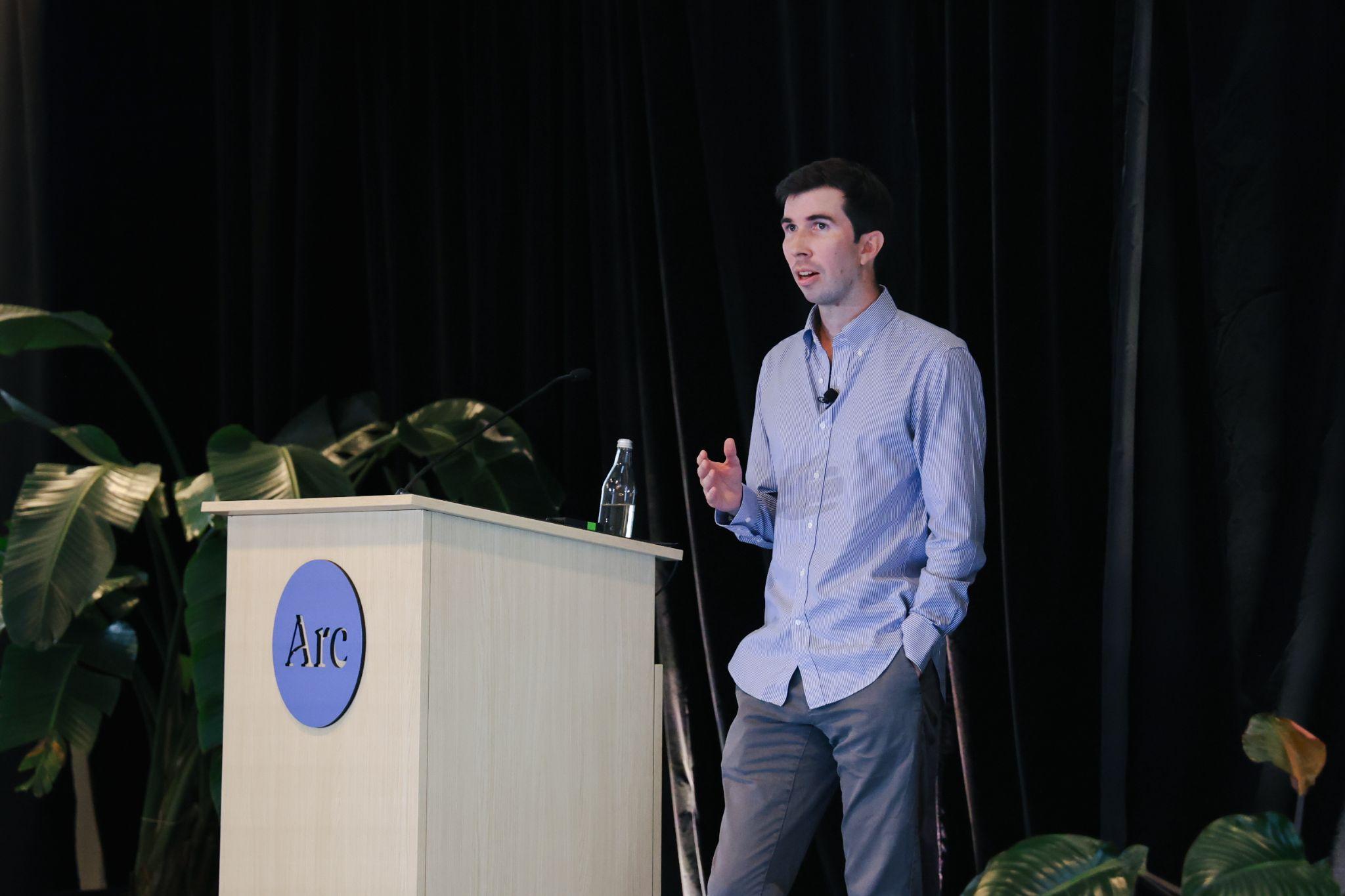
Four years ago, John Pluvinage was a neurology resident at UCSF trying to solve one patient's mystery: a 67-year-old woman whose memory and ability to walk were declining, whose bloodwork kept coming back normal, and whose diagnosis was inconclusive.
Pluvinage and his collaborators went looking for an explanation that the standard diagnostic tests were missing. They soon had a primary suspect in an autoantibody targeting CD320, the receptor that ferries vitamin B12 across the blood-brain barrier. It appeared that this patient’s immune system was blocking CD320 function, impairing B12 transport into the brain, and causing the unusual neurologic symptoms. To test this, they did something unusual. Instead of evaluating only B12 serum levels, they also examined B12 levels in the patient’s cerebrospinal fluid. While her serum B12 levels looked fine, her cerebrospinal fluid was shockingly low in B12.
That single case became a new diagnosis: autoimmune B12 central deficiency, or ABCD. And, to the team's surprise, the same anti-CD320 autoantibody turned up in a striking fraction of patients with dementia (10%), lupus (20%), and unexplained spinal cord disease (50%).
Pluvinage, now a Core Investigator at Arc Institute and Assistant Professor of Neurology at UCSF, has spent the past few years testing how ABCD and B12 metabolism in the central nervous system impact a wide range of neurological disorders, and building potential treatments. A preprint published earlier this year showed his team's progress on the therapeutic side. They used structural biology to map exactly where these autoantibodies bind CD320, then engineering a targeted protein degrader, a LYTAC, to eliminate them from the bloodstream without broad immunosuppression.
That therapeutic work is guided by clinical observations that Pluvinage and colleagues published today in JAMA Neurology. Below, he shares what they learned conducting one of the largest investigations yet of idiopathic myelopathy—spinal cord dysfunction with unknown origin, even after exhaustive clinical tests—and what anti-CD320 autoantibodies might have to do with it.
After your initial discovery of ABCD, how did you go about characterizing it in larger clinical populations?
Once we published the first case, people started sending us similar ones. B12 deficiency in the blood can manifest in very different ways depending on the individual. It can affect the brain, leading to cognitive dysfunction; the spinal cord, leading to numbness and weakness; or even the autonomic nervous system. When we looked at other patients who had been enrolled in this autoantibody discovery project, we realized that some of them had symptoms somewhere along that spectrum.
One of the original eight patients had a very specific spinal cord disorder that resembled subacute combined degeneration, a classic manifestation of B12 deficiency. But, in this patient's case, his B12 was completely normal in his blood. It was only when we actually found the antibody, and looked in his cerebrospinal fluid, that we realized he had ABCD.
That got us asking a bigger question: in other patients with spinal cord dysfunction, could autoantibodies be contributing to disease, especially in cases that never reach a definitive diagnosis?
So, we screened for anti-CD320 autoantibodies in about 150 patients from a multinational cohort with spinal cord dysfunction of unknown origin. We expected to find anti-CD330 autoantibodies in a handful of patients. Instead, we found them in half. Many of these patients also had evidence of B12-related metabolic dysfunction in the central nervous system. But, in nearly all of them, B12 deficiency had been dismissed early on simply because their serum levels looked normal.
A few patients tried vitamin B12 supplementation. What happened?
In the original case that led to the discovery of ABCD, the patient was empirically treated with B12 supplementation. Her serum B12 level shot through the roof, but we also saw the concomitant rise in the level of B12 in her cerebrospinal fluid. A few months after treatment, some of her cognitive deficits improved. Now, I'm not saying this as any sort of proof of efficacy, but it’s an interesting patient perspective of illness, and the kind of stuff that motivates us to take this forward.
In our current study—and this again is anecdotal, not a controlled trial—five patients received systemic B12 supplementation, with or without immunosuppression, and four out of five partially improved.
How can we better treat patients with ABCD?
That question became the basis for our recent preprint on targeted antibody degraders in ABCD. What we focused on was adapting existing antibody-degrading technology for a prevalent neurological condition, with the goal of pushing the therapeutics side forward. That began with defining the structural basis of how these autoantibodies bind CD320 and then engineering a degrader that clears them from circulation. In essence, we used the conserved CD320 protein epitope as “bait” conjugated to a lysosome-targeting glycan ligand. While pathogenic autoantibodies get dragged to lysosomes for degradation, the rest of the immune system remains intact.
The exciting part here is that the binding epitope is highly conserved across patients, so it may be broadly applicable. A targeted degrader like this only scales if it can display a shared epitope, rather than needing to be custom-built for each patient's unique antibody.
What do you hope clinicians and researchers take away from this work?
I hope that it spreads awareness. There are no clinical diagnostic tests for this condition currently. That’s a huge barrier. People email us constantly asking if we can test their patient, and the honest answer is only through enrolling in a research study. This work is slow, and our test can't yet inform clinical decision-making. But we're hoping other health centers pick this up so that testing eventually becomes clinically available.
I also hope it's a roadmap for other neurologic diseases: start with careful clinical characterization, follow it down to the structural mechanism, and use that to drive therapeutic development.
Even with all the advances in diagnosis over the years, one of the most common diagnoses for spinal cord dysfunction is “idiopathic”. Distinguishing subtypes of a disease is one tractable path toward developing effective treatments.
What's next for the Pluvinage lab?
What excites me now is understanding the origin of these autoantibodies in a human system: why do they develop? Is there a genetic predisposition? An environmental trigger? If we can understand the origin story of autoimmunity, maybe we can move from reactive treatment toward actual prevention. I’d like to explore that.
Another goal of my lab is to consider the autoimmune component in diseases that weren't previously thought of as autoimmune conditions at all. In particular, I'm really fascinated by how comorbid autoimmunity is enriched in a lot of neurodegenerative disorders. Is that just an association, or is there an actual causal contribution of autoimmunity to neurodegeneration?
How do you plan on studying the origin of CD320 autoantibodies?
We're actively recruiting the right people to pursue this. We’re trying to develop ways to look across all human proteins in a more physiologic context, accounting for the intricacies of protein folding and glycosylation, to test not just whether an antibody binds an autoantigen, but whether that binding affects the function of the target protein. These technologies will hopefully allow us to investigate the hypothesis that pathogenic autoantibodies exacerbate dementia, and, even more exploratory, that protective autoantibodies exist in cognitively resilient individuals.
Why did you decide to become a physician-scientist?
I was inspired by my mentors, who showed me the path and supported my journey. Seeing patients helps clarify what questions are actually meaningful, and research training gives you the tools to probe those questions hopefully towards improving human health more broadly.
Practically, it's nice to have two different jobs: one where you're trying to help one person at a time, where you see a patient and you can immediately do something, even if it's just counseling. In the lab, the potential impact could be huge, but on a five-, ten-, or twenty-year timescale. It’s a completely different pace, where everything happens more slowly. Having both perspectives keeps me sane.
What would you say to a patient, or a family member of a patient, reading about this?
I'd want to be as careful and tempered as possible. We are not saying we found the answer for everyone: we found an association in about half of our patients. While this autoantibody is tied to low B12 in the cerebrospinal fluid, we don't yet know whether it's a driver of disease or just a passenger, and it can coexist with other conditions. But it's a promising lead, especially because it may be treatable, and we think it’s something patients and physicians should know about.
Pluvinage, J.V., Acero-Garces, D., Greco, G., Moseley, C.E., Sidhu, S., Zorn, K.C., Kondapavulur, S., Mohan, S., Neely, J., Masciocchi, S., Businaro, P., García Sarreón, A., Gifreu Fraixinó, A., McCutcheon, K., Caspar, C., Dela Rosa, R., Zamecnik, C., Tubati, A., Asencor, A.I., Tugizova, M., Chow, F., Galati, A., Mina, Y., Toro, C., Kang, M., Guo, C.-Y., Wesley, S.F., Kvam, K., Lee, S., Abdelhak, A., Martin, T., Huang, Y.-H., Berman, S.B., Linnoila, J., Engstrom, J., McCaddon, A., Green, A.J., Green, R., Cree, B.A.C., Hauser, S.L., DeRisi, J.L., Pleasure, S.J., Gelfand, J.M., Álvarez Bravo, G., Gastaldi, M., Pardo, C.A. & Wilson, M.R., the UCSF Neurohospitalist Division, the UCSF Neuroimmunology Fellowship, and the UCSF Neurology Residency Class of 2025. Anti-CD320 Autoantibodies and Central Nervous System Vitamin B12 Deficiency in Idiopathic Myelopathy. Jama Neurology. https://doi.org/10.1001/jamaneurol.2026.2778