
Hiroshi Nishimasu
Patrick Hsu
Overcoming the insertion bias in natural bridge recombinase systems for efficient excision
Programmable biology has arrived in a few different ways, each time defined by a new type of RNA-guided mechanism: RNA interference, then CRISPR systems for programmable cutting of nucleic acids. More recently, in 2024, we uncovered the first RNA-guided DNA recombinases. These bridge recombinases bind bridge RNAs: bispecific guide RNAs able to recognize two different DNA molecules simultaneously.
For decades, genome engineering has had a fundamental trade-off. CRISPR gives us programmability, but it’s mostly limited to small edits, while recombinases can perform larger rearrangements but require pre-defined target and donor sequences. Bridge recombinases solved this trade-off by enabling programmable recombination in which both DNA molecules are specified by the bridge RNA. This allows us to control the directionality of genome rearrangement: by designing a bridge RNA to bind desired DNA fragments in a specific orientation, we can insert, excise, or invert any two DNA sequences through a single unified mechanism.
But while the bridge recombinase system can control the directionality of genome rearrangement, it is not equally proficient in all directions. Excision, in particular, is an inefficient process. In collaborative work with the Nishimasu lab now published in Nature, we uncovered the structural and mechanistic rules governing this imbalance. By understanding the biology underlying the bridge system’s ability to excise bRNA-defined segments of DNA from the genome, we provide a roadmap towards therapeutic excision of pathogenic repeats and other excision applications going forward.
The Structural Mechanism of Bridge Excision
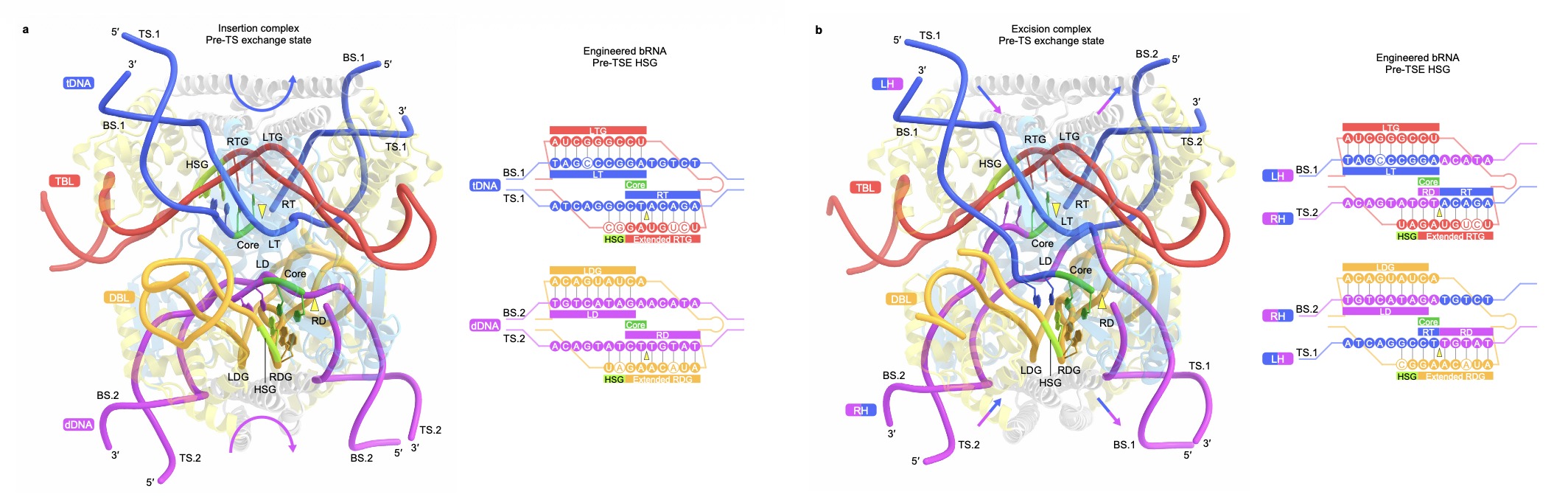
We first discovered bridge RNAs within IS110 insertion sequence elements, a class of minimal, autonomous bacterial transposons, or “jumping genes”, that use their encoded bridge recombinase to excise and paste themselves across genomes. In 2024, we solved structures of the IS621 bridge recombinase complex from E. coli with target and donor DNA fragments bound to mimic the insertion reaction, and in our new work we captured snapshots of the complex undergoing excision. While insertion and excision rely on the same tetrameric recombinase complex to orchestrate strand exchange through a Holliday junction-like intermediate, we found that excision is not just the insertion reaction running in reverse. Rather, a core biophysical limitation dictating the inefficiency of excision lies in the geometry of the DNA itself.
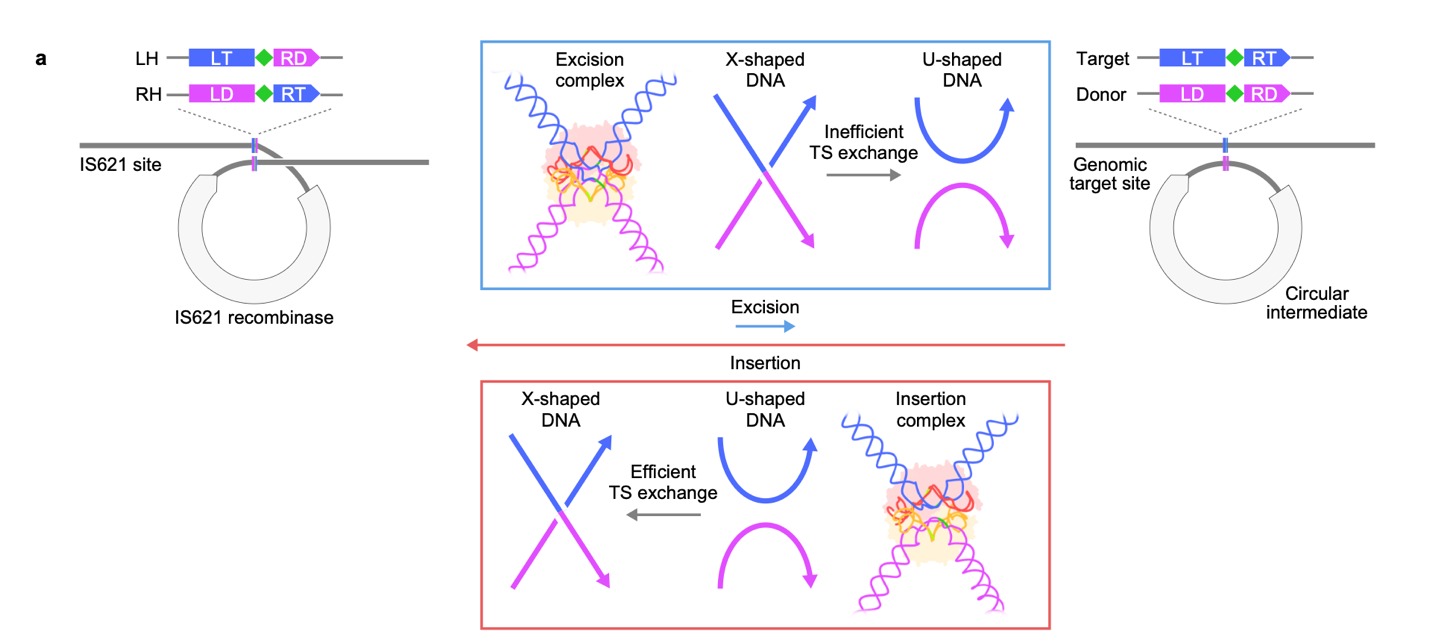
During insertion, each DNA substrate enters a highly strained U-shape that acts like a loaded spring. This physical strain is like bending two pieces of dry spaghetti, where the pent-up energy creates a massive drive for the strands to snap outward upon cleavage, promoting strand exchange and recombination. During excision, the DNA strands do something entirely different: instead of bending into U’s, they cross over in a relaxed, linear X-shape. While the enzyme can still cut the DNA effectively, the cleaved DNA strands have less impetus to swap places.
And, in the context of this transposon system jumping around bacterial genomes, there’s an extra factor working against excision efficiency. We previously showed that bridge RNAs have two loops to direct a sequence-specific insertion reaction: a target-binding loop (TBL) that binds a site in the genome, and a donor-binding loop (DBL) that recognizes the IS110 element itself. Successful insertion therefore creates two chimeric sites, each with a segment of the target and a segment of the donor. To excise this element, both the TBL and DBL must bind across two DNA molecules rather than one. Not only is this likely less favorable biophysically, it’s also harder to achieve in the context of a crowded living cell. We showed in previous work that bridge recombinase tetramers containing two TBLs (rather than one TBL and one DBL, or two DBLs) are unable to catalyze recombination; we thus hypothesize that this chimeric recognition may also drive the formation of more unproductive complexes. It makes evolutionary sense that IS110 systems would favor insertion over excision to promote their own selfish spread within and between genomes, and our findings are starting to illuminate how that preference is achieved.
Engineering Tools to Steer Recombination
Conceptually, the core recombination mechanism of the bridge system is digital: the physical exchange of DNA strands either happens or it doesn’t. But Handshake Guides (HSGs)–programmable guide-RNA dinucleotides on the binding loops of bRNA–act as an analog switch or dial that can be turned up or down to modulate the efficiency of that reaction.
We found that the naturally occurring bridge RNA is rigged to favor insertion: HSGs form only one base pair with the DNA before top-strand exchange (TSE), but immediately snap into three base pairs after exchange. The transition from fewer to more base pairs creates a thermodynamic ratchet, physically pulling the reaction forward and making the insertion reaction energetically favorable. This process may be motivated by evolutionary urgency towards rapid reinsertion, while keeping excision slow and inefficient to ensure these elements reside stably in the genome.
Rather than a rigid, zero-sum engineering rule, this biophysical asymmetry is a constraint of the natural transposon that we can actively override. By recognizing how these reactions are directionally governed, we can design custom HSGs to deliberately favor the post-strand exchange state for our chosen reaction. For insertion, we can optimize post-TSE base-pairing to maximize efficiency and favor payload stability in the genome. For excision, we can rewrite HSG sequences to maximize base-pairing in the post-TSE state of the excision pathway to thermodynamically motivate excision and dramatically increase its efficiency. In fact, by engineering HSGs to favor the post-TSE excision state, we increased excision efficiency by 13,000-fold in E. coli. By detailing the engineering principles underlying bridge recombination reactions, we hope to offer a practical guide for optimizing bridge RNAs and recombinases to favor insertion or excision for deterministic genome design.
###
Hiraizumi, M., Athukoralage, J.S., Perry, N.T., Tsujimoto, E., Shiojiri, N., Nagahata, N., Lee, L., Sun, G., Durrant, M.G., Chandrasekaran, S.S., Konermann, S., Yamashita, K., Hsu, P.D., Nishimasu, H. Structural mechanism governing the directionality of bridge recombination. Nature. https://doi.org/10.1038/s41586-026-10903-y
Hiroshi Nishimasu (X: @hnisimasu) is a Professor in the Department of Chemistry and Biotechnology at The University of Tokyo.
Patrick Hsu (X: @pdhsu) is an Arc Institute Co-Founder and Core Investigator and Assistant Professor of Pathology at Stanford University.