
Brian Hie

Ivan Specht

Soyoon Park

Talal Widatalla
antiGen and Germinal Multi: Forecasting viral evolution and designing antibodies for future variants
Monoclonal antibodies were an important early tool against COVID-19. Nearly 70,000 high-risk patients in the US were treated in the first five months alone, and studies have linked early treatment to fewer hospitalizations and deaths. But as SARS-CoV-2 mutated, those treatments lost their effect, in some cases in less than two years. Finding antibodies that hold up across variants is possible, but it can require extensive screening that struggles to keep up with the evolving virus.
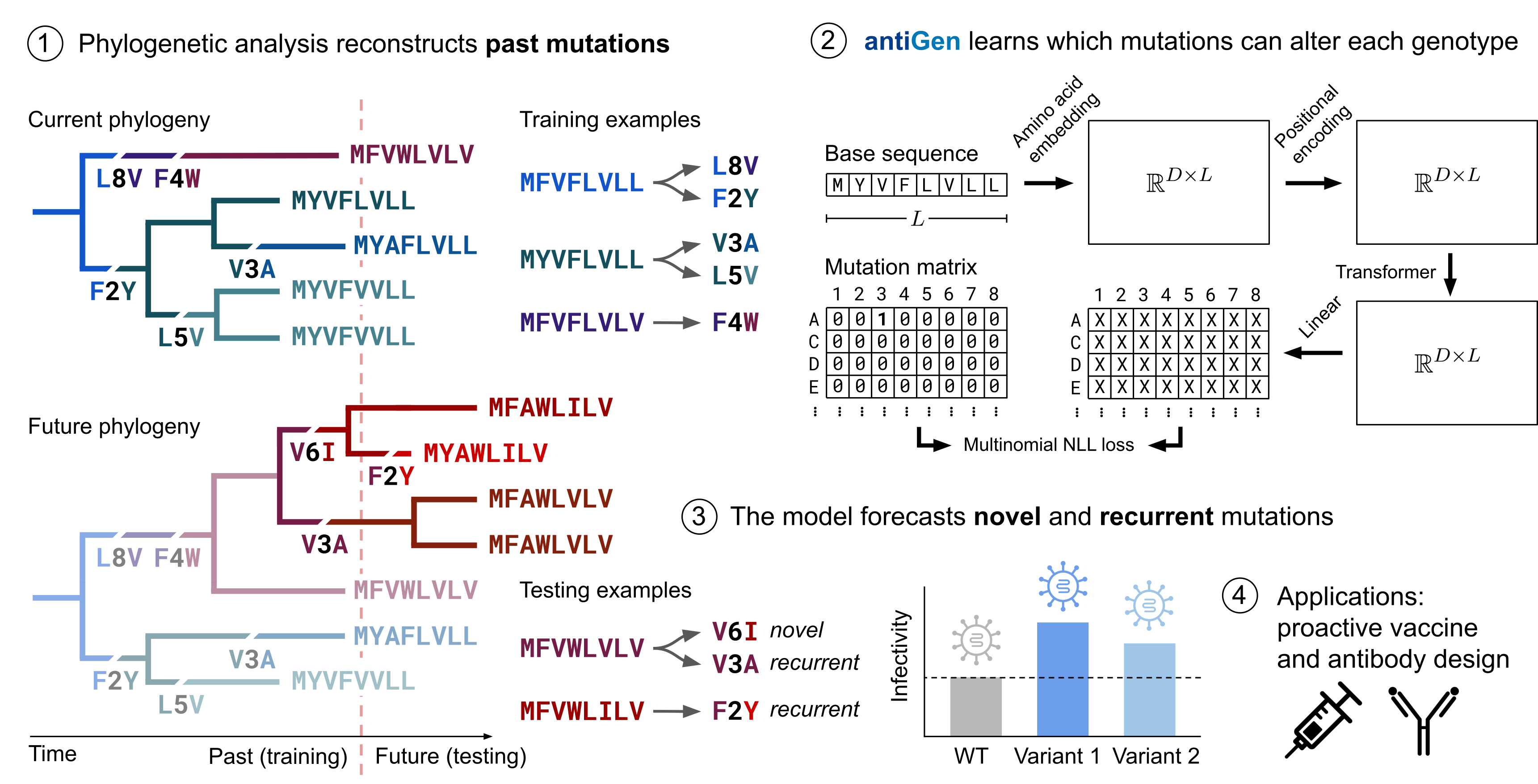
As a lab interested in applying ML to biological design, we are offering two new tools to tackle this problem. antiGen forecasts mutations by learning from the changes a virus has already made along its evolutionary tree, rather than from sequences alone. Germinal Multi designs a single antibody against several variants of a target at once.
We combined the two approaches to redesign an antibody for broader binding, which also translated into broader neutralization in laboratory tests. The original antibody neutralized XFG but not XFG-Next, an XFG variant combining forecasted mutations, whereas the redesigned antibody neutralized both.
antiGen: Learning from a virus’s past
Every virus leaves behind clues about its own potential future, written in the mutations that allowed it to survive. When we first tested how well existing forecasting models performed, we were surprised to find that once a pandemic has been underway for even a few months, simply counting how often mutations had already occurred was highly predictive of what came next. But a count can only point to mutations that have already been observed. We wanted to create something that could also anticipate mutations that hadn’t happened yet.
antiGen is a small model, roughly half a million parameters, trained directly on phylogenetic trees. Rather than trying to tease patterns out of large, unstructured sequence databases, it learns from mutations as they happened in the evolutionary past. To do this at the scale of COVID-19, we created our own tree-building algorithm, inspired by UShER but built to handle protein sequences and account for sequencing ambiguity, and used it to place up to 9 million publicly available SARS-CoV-2 spike sequences on a tree seeded from Nextstrain.
When we trained antiGen on data through 2023, about 7.8 million sequences spanning 240,000 mutations, it predicted future mutations more accurately overall than the other methods we compared it to. Its largest lead was on mutations that had never appeared in the training data and were accessible through a single nucleotide change. It also forecast what later showed up in real-world surveillance. Over half of receptor-binding domain escape mutations landed in antiGen’s top 10% of predictions, including all but one on the evolutionary trajectory from the BA.2.86 variant to the KP.3 variant, which was highly prevalent in summer 2024.
antiGen does best with plenty of data. But even with data only up through the beginning of 2021—about 350,000 sequences encompassing 14,000 mutations—it still outperformed previous methods at the key task of predicting which novel mutations would appear in 100 or more samples, and hence would likely be considered of public health importance. On some evaluations, a simple count of past mutations can beat antiGen at picking out the very top predictions early on in a pandemic, so we also built a hybrid that leans on raw frequency when data are scarce. The hybrid matched or exceeded either approach at every stage we tested, from 2020 to 2024. antiGen also performed well on influenza, RSV and dengue, which have far less sequencing data.
To test whether the forecasts were biologically plausible, we built antiGen’s top predicted mutations into the spike of XFG, a variant circulating at the time, using non-replicating pseudoviruses. Most still infected cells. Six of the top ten predictions, and four of the ten top-ranked never-observed mutations, were as infectious as XFG or more. Two of the never-observed mutations had no measurable infectivity.
Germinal Multi: Designing evolutionarily resilient antibodies
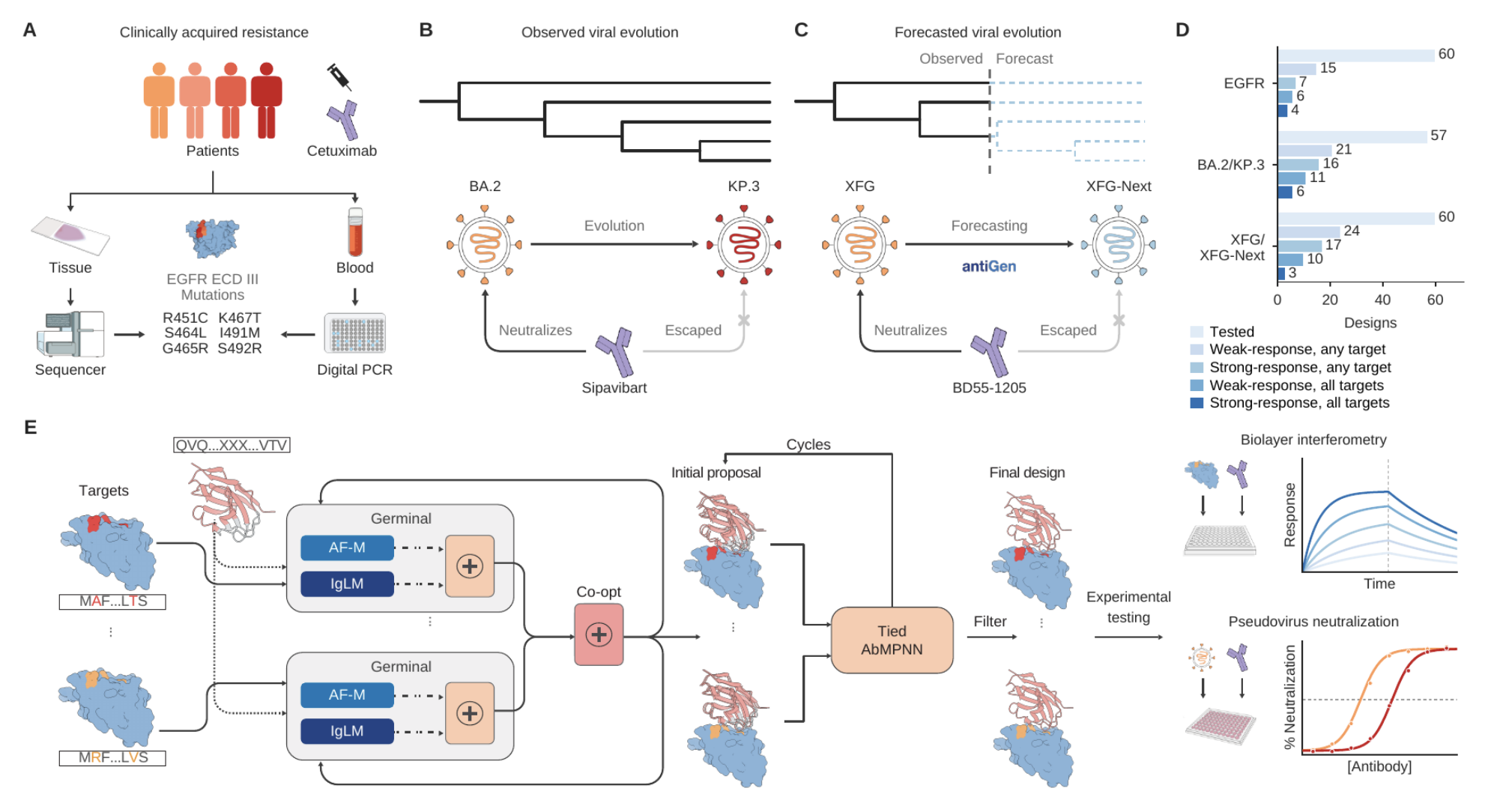
Germinal, which we released last year, designs antibodies against a single target. But as we saw with COVID-19, an antibody tuned to one version of a target can fail on the next. Germinal Multi extends the approach by testing a single antibody design against several versions of the target at once on a computer, and keeps it only if it’s predicted to bind all of them. We also added a second mode that starts from an existing antibody and keeps the redesign close to the original’s sequence and the way it sits on its target, which would enable redesign instead of replacement of an antibody that has lost activity.
Sipavibart, a clinical antibody, worked against earlier Omicron variants and then stopped working against KP.3. We used Germinal Multi to design entirely new antibodies, from scratch, against the site on the spike that sipavibart binds, on both BA.2 and KP.3. Of the 57 designs we tested, the best, R50, blocked both variants from infecting cells. It also bound variants we had left out of the design, a sign that its breadth reaches beyond the two we gave it.
Antibody resistance isn’t limited to viruses. In some colorectal cancers, resistance to the antibody drug cetuximab has been traced to mutations in EGFR, the protein it targets. We chose six EGFR mutations that have been reported in patients and cell models. Rather than designing against each one separately, we built a single target that carried all six and designed against it alongside unmutated EGFR. Five of the 60 designs bound unmutated EGFR and every one of the six single-mutation variants, even though they never saw those variants on their own.
Putting them together
A forecast can’t tell you exactly which mutation a virus will make next, but it can narrow thousands of possibilities to a short list of plausible ones, enough to give antibody designers something to prepare for. To see whether that works in practice, we started with BD55-1205, a broadly neutralizing antibody that stops XFG from infecting cells, and asked what a variant that defeats it might look like.
We ranked possible changes to the XFG spike using forecasts from our antiGen work, then used published experimental data to find the ones the virus could tolerate and that might weaken the antibody. That left three: A475V, E493R and Y501T. Each on its own left the pseudovirus infectious. Combined in a single spike, which we call XFG-Next, they were completely insensitive to neutralization by BD55-1205.
Then we asked Germinal Multi to redesign BD55-1205 to work against both XFG and XFG-Next. Of 60 redesigned antibodies, the lead, X51, blocked infection by both. It cut infection in half at 2.1 ng/mL against XFG and 6.3 ng/mL against XFG-Next. Binding alone didn’t tell us which designs would work. Another design, X58, bound both variants but blocked only XFG. This highlights the importance of testing whether an antibody stops infection after confirming it can recognize the target.
See an example of how we did this below:
Sequencing data keeps growing, and we expect the next pandemic to be sampled even more densely than COVID-19. antiGen is a proof of concept that, processed the right way, those data can narrow the next evolutionary steps to a short list of plausible changes. The most immediate use is on viruses that are already tracked closely, like seasonal influenza and SARS-CoV-2. Because it needs only a phylogenetic tree with mutations mapped onto it, the same approach could be tried on bacterial pathogens or in cancer. We also want to understand what antiGen has learned, since it predicts mutations that have never been seen.
antiGen can’t yet tell us which of the variants already circulating will be fitter than the others. There are tens of thousands of spike mutations to learn from, but many fewer cases in COVID-19 where we can say conclusively that one variant outcompeted another, so there’s far less to train on, and the answer may need a different kind of model. On the antibody side, we’re interested in whether there’s a general principle behind how an antibody matures from a naive starting point into a strong binder, and whether phylogenetic trees can help reveal it.
Both tools are free to use and we’d love to hear from anyone who tries them.
Biosafety, biosecurity, and pandemic preparedness
Forecasting how viruses might mutate is an established area of research, but it can raise questions about safety. antiGen proposes single amino acid changes, which leave a sequence similar enough to existing viruses that DNA synthesis screening based on sequence homology should flag them as readily as existing strains, and it does not design new pathogens. For our antibody work, to test whether a redesigned antibody could hold up against an anticipated change, we combined three individually tolerated substitutions into one engineered spike, XFG-Next. We did this only in replication-incompetent pseudoviruses, which can enter a cell once and cannot spread, under approved institutional biosafety procedures at BSL-2 containment, and we did not test whether XFG-Next would transmit or cause disease.
We hope both of these tools could aid in pandemic preparedness and biodefense efforts. Public health officials could use evolutionary forecasts to guide surveillance, diagnostic efforts, and vaccine selection. Work like this moves us toward a future where we can more rapidly respond to diseases that quickly mutate, such as viral infections or cancer, with evolutionarily resilient therapeutics.
Specht, I., Park, S., Vermani, A., Chithrananda, S., Driscoll, C.L., Brixi, G., Palacios, J.A., Hie, B.L. (2026). Forecasting viral evolution from phylogenetic trees. bioRxiv. https://doi.org/10.64898/2026.08.27.741102
Park, S., Widatalla, T.M., Driscoll, C., Mille-Fragoso, L.S., Specht, I., Gao, X.J., Hie, B. (2026). Antibody design across observed and forecasted antigenic evolution. bioRxiv. https://doi.org/10.64898/2026.11.10.765734
antiGen and Germinal Multi are available on Github.
Ivan Specht (X: @ivan_specht) is a PhD student in Computational and Mathematical Engineering at Stanford University and Arc Institute.
Soyoon Park is a PhD student in Bioengineering at Stanford University and Arc Institute.
Talal Widatalla (X: @talaldotpdb) is a PhD candidate in Biophysics at Stanford University and Arc Institute.
Brian Hie (X: @BrianHie) is an Assistant Professor of Chemical Engineering at Stanford University, the Dieter Schwarz Foundation Stanford Data Science Faculty Fellow, and Arc Institute Innovation Investigator in Residence.