Meet some of the 2026 Virtual Cell Challenge competitors
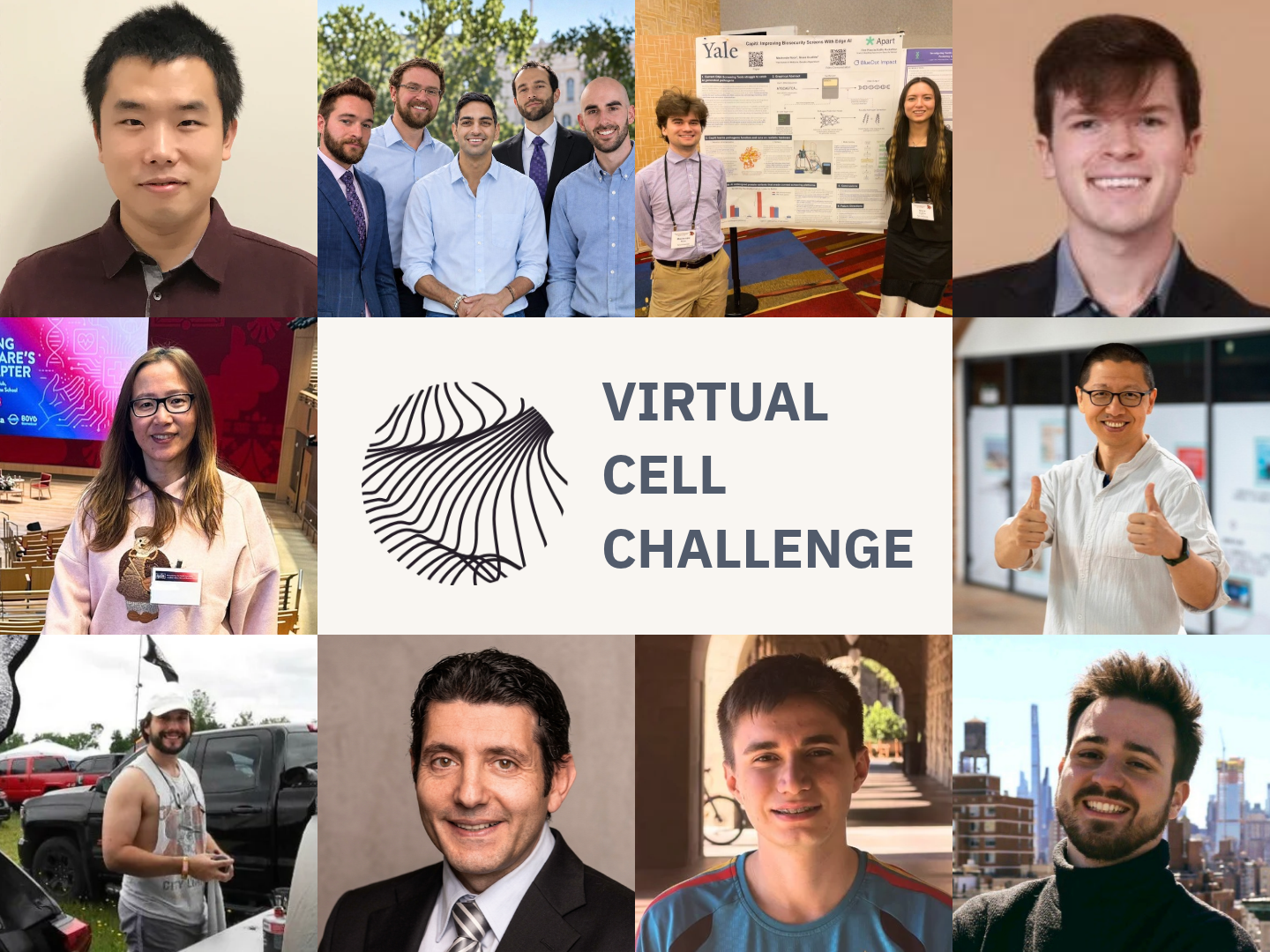
One of the goals of the Virtual Cell Challenge is to build a community of people who see the possibilities of applying machine learning to complex biology. We applaud the more than 5,000 registrants and 1,500 teams on the leaderboard, but we were curious to learn more about who exactly is taking part. So we invited competitors to fill out a short survey to tell us why they’re participating, how the Challenge relates to their work, and what they want the world to know about them. You can see some of these answers below.
Thank you to everyone who took the time to reply, and to our sponsors, NVIDIA, 10x Genomics, and Ultima Genomics, for making the Challenge possible. We look forward to sharing more competitor stories when we announce the winners on Thursday, November 19.
Team cqawesome
Why are you participating?
The Virtual Cell Challenge brings together two areas I care deeply about: functional genomics and AI. My background in functional genomics gave me a strong biological foundation for understanding the perturbation-prediction problem, so I came into the Challenge already thinking carefully about what signals should matter biologically. My goal is not only to build a high-performing model, but also to explore whether AI can help us discover biology that we would not have recognized otherwise. I’m especially interested in designing better AI harnesses—ways of combining models, biological priors, and iterative reasoning—to push beyond prediction toward generating new scientific hypotheses.
How does the Challenge relate to your work?
The Challenge is closely aligned with my work in functional genomics, where a central goal is to understand how perturbing genes changes cellular states and phenotypes. It’s a concrete setting to explore how AI can complement traditional functional genomics, uncover latent biological relationships, and prioritize experiments.
What do you want the world to know about you?
My “team” is a little unusual: I’m participating solo, with a large collection of AI agents as collaborators. I hope our participation shows how powerful a well-designed AI harness can be when paired with strong biological intuition and careful human oversight, even against larger teams with multiple collaborators.
Team newlife
Why are you participating?
Coming from a background in education, I want more people to realize that entering a competition may be the fastest way to learn something new. Learning by doing is many times more efficient than the way we normally learn in school: you get a real problem, real feedback, and no way to fool yourself about whether you actually understood something.
How does the Challenge relate to your work?
It has nothing to do with my work or my studies—it is purely a hobby. What it has given me is a much sharper understanding of how efficient learning actually works. And, of course, a great deal of biology: the principles behind the virtual cell, and the practical craft of working with the data.
What do you want the world to know about you?
One person, on a gap year. Two computers and an AI subscription.
Team Reilly Lab
Why are you participating?
In our current research, we work on predicting the enhancer activity of a DNA sequence. But a wider, more difficult question we hope to eventually answer is how differences in cell state alter function and cause disease. The Virtual Cell Challenge is a fun way to try to predict that next step, or at the very least, try to understand what is possible with current methods and data.
How does the Challenge relate to your work?
The Reilly Lab develops high-throughput experimental and machine learning methods to understand regulatory DNA, interpret how genetic variation alters it, and write new regulatory elements de novo. Across applications and phenotypes, we use evolution as a lens to study how genetic variation shapes function at the molecular, cellular, and organismal levels, driving human traits, disease, and adaptation. This Challenge pushes us to go a step further: beyond predicting changes in enhancer activity itself, to understanding how those changes propagate and alter cell behavior, and ultimately drive hereditary disease.
What do you want the world to know about you?
We're both looking for opportunities to continue in computational genomics past graduation. Grace is applying for PhD programs this cycle, and Mackenzie is finishing his PhD dissertation, and we're both interested in applying machine learning to genetic questions. If you're looking for PhD students or graduates in this space, please reach out!
Team Ahmet Dedeler
Why are you participating?
I'm 18, on a gap year, building consumer apps full time. I've always wanted to contribute to science and health, so the Virtual Cell Challenge has been a great opportunity for me to get involved — anyone, anywhere can participate. I've also found the clear feedback loop and leaderboard pretty nice, as it lets you immediately see how well you did! So far, I've had 400 logged experiments and 850 commits, and a spot in the top 20 out of 1,000+ teams.
How does the Challenge relate to your work?
As a software engineer, VCC has allowed me to experiment with new ways of working with LLMs. For example, spawning a ton of cloud agents on Cursor or orchestrating various frontier models (what's the optimal amount?). I think finding new approaches for leveraging models and harnesses is a very interesting area.
What do you want the world to know about you?
I enjoy learning by doing. That's what drew me to the Virtual Cell Challenge: it's competitive, meaningful, and instructive. I look forward to seeing this framework applied to other fields as well, measuring ideas scientifically and running a /goal on any topic: diseases, technological breakthroughs, social goals, etc. Excited to build!
Team Silver Labs
Why are you participating?
I build computational tools for structural and cellular biology, and the Virtual Cell Challenge is the cleanest benchmark I know of for a problem I care about: predicting what a cell does under a perturbation nobody has run. My goal is to find out how far a carefully built approach using only openly licensed data can get against models trained on much larger private corpora, and to understand precisely where it breaks. So far the negative results have taught me more than the positive ones.
How does the Challenge relate to your work?
I’m an independent researcher working as Moore Neural. My main released tool, Lacuna, finds cryptic binding pockets that are invisible in a single static structure by surfacing sites that appear only transiently. Lacuna and this Challenge are the same question in two settings: what is real but invisible in a single snapshot? K-Ras was called undruggable for decades because its key pocket was hidden in static structures. A cell’s response to an unseen knockdown is hidden the same way: the information is there in how related perturbations behave, but not in any one measurement.
What do you want the world to know about you?
It's one person and one desktop GPU, with openly licensed datasets. That constraint has cost me some obvious shortcuts, and I think the result is better for it. I also keep a detailed record of what hasn't worked: an approach that collapsed identically across four configurations and three local scoring proxies that each mis-predicted the leaderboard. I plan to publish that alongside the code once the Challenge closes, because the failures are the part that would actually save someone else time.
Team Dana A
Why are you participating?
I am wanting to further improve my modeling skills and find jobs in this area later.
How does the Challenge relate to your work?
I am working on the genetic perturbation screening myself and prioritizing hits, and validating targets. It is very natural for me to work upstream to predict targets for screening. I am aiming for a loop between virtual cell prediction to screening.
What do you want the world to know about you?
I own the end-to-end target discovery from prediction and perturbation screening, prioritization and target validation. I am closing the loop on AI and biology for target/drug discovery.
Team Slurm Shadi
Why are you participating?
I joined to prove to myself that I could build something, on my own, that could compete with models from top universities and companies. I also wanted to learn, push my technical limits, and validate that the scientific thinking behind Cosnetix is real and that I truly understand the biology and modeling behind what I’m building.
How does the Challenge relate to your work?
My work focuses on bioinformatics, single-cell genomics, and computational modeling. The shortcomings of existing biology foundation models, including Geneformer, convinced me there was room to build something better. The Challenge gives me a way to test that belief by moving beyond describing cellular states and predicting how cells respond to perturbations.
What do you want the world to know about you?
My team is just me. I built the full pipeline myself, from data exploration and modeling to validation and submission. Competing solo and reaching the Top 10 has been a personal proof point that one person can still build something competitive against much larger teams.
Team Theo Botella
Why are you participating?
My goal is to build my own autonomous AI-scientist workflow that can compete at the top, and to learn where the model excels and where it fails. It's also a great way to spend real time working side by side with a model on an open problem and to understand how we work best together.
How does the Challenge relate to your work?
I'm a computational biologist building single-cell methods and tools for drug target discovery. Predicting perturbation responses in cells is close-ish to my day job. But I'm mostly excited about the agentic shift happening in science right now. My personal goal is to develop agents that speed up my research and increase my output, and that let me discover things I couldn't have found alone. The Challenge is a great testbed for that, and a lot of fun.
What do you want the world to know about you?
My approach is to explore what science looks like when every scientist can build their own research team out of AI. I hope my success in this Challenge inspires more scientists to join the journey and build agents for biology and AI scientists, pushing the frontier of science and what humanity can achieve in the next decade.
Team CellMind Collective
Why are you participating?
CellMind Collective is a collaboration exploring whether continuity, constructive disagreement, and learning from measured outcomes can make human–AI collaboration more effective at solving scientific problems. The Virtual Cell Challenge gives us a concrete opportunity to put that idea to the test.
How does the Challenge relate to your work?
The Challenge connects directly to my work on AI-assisted software development and computational modeling in the LivingCellSimulation project, bringing together literature research, machine learning, and reproducible experimentation.
What do you want the world to know about you?
What makes this project meaningful to us is the opportunity to learn through a real scientific challenge. We hope our experience encourages others to explore human–AI collaboration while keeping responsibility, reproducibility, and honest reporting central to the work.
Team em2.bio
Why are you participating?
When our team lead, Dr. Meadow, told us about the competition, we were eager to use our diverse skill set to help advance computational biology. At first, we were happy just to be in the top half when there were 300 teams. Now that we've been consistently in or near the top 25, our competitive drive keeps us iterating and improving.
How does the Challenge relate to your work?
None of our jobs are anywhere close to this. For example, Jason is a video game software engineer, and Andrew is getting his PhD in chemical engineering. But with the rise of AI, and our workplaces encouraging us to build proficiency, we used this challenge as a way to sharpen our skills.
What do you want the world to know about you?
For starters, our team lead, Dr. Meadow, just put himself on the job market. If he can lead a few engineers who started out knowing nothing about the field to the top 2% of the competition, imagine what he can do for your company with real resources. At the end of the day, we're just friends having fun solving puzzles together.