The Language of Chromatin, Decoded
A conversation with Hani Goodarzi and Vijay Ramani
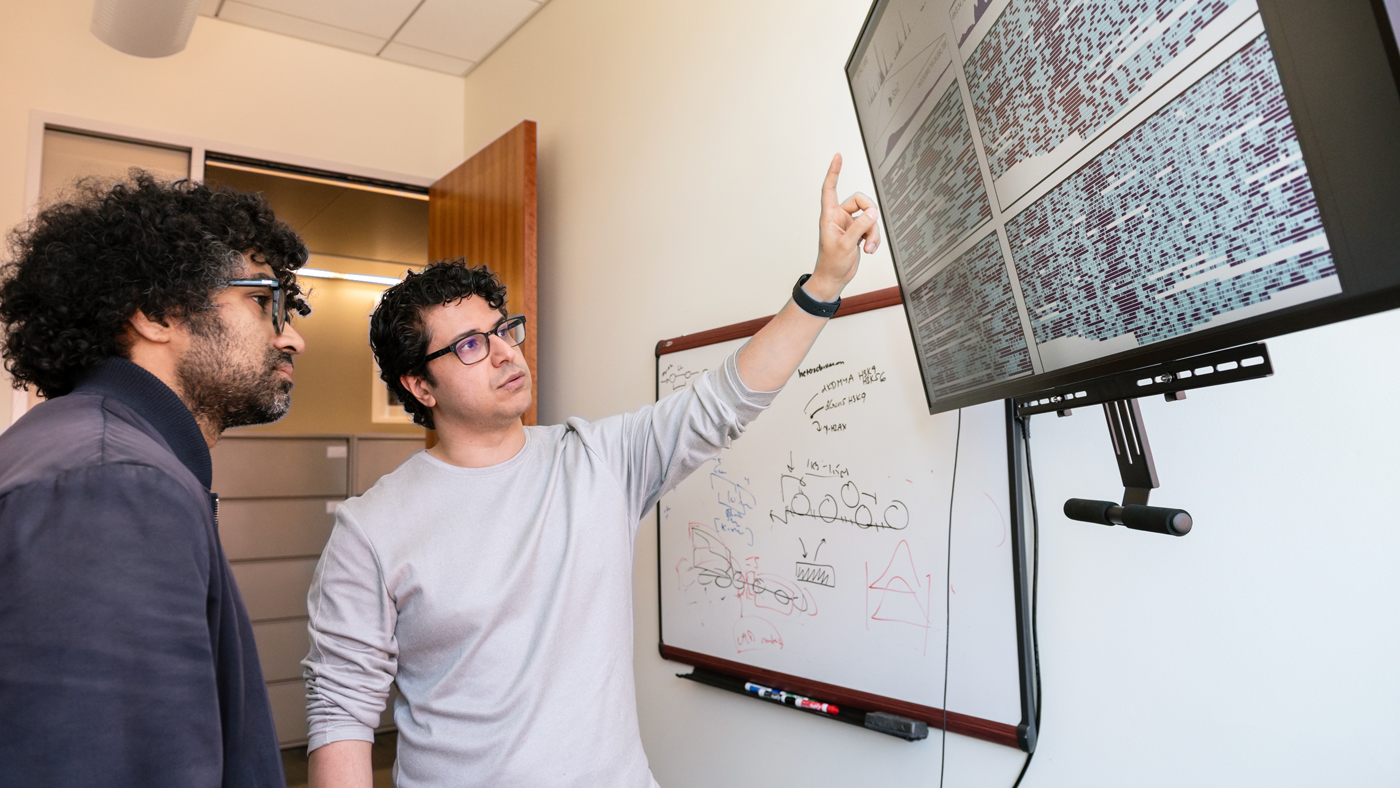
The nucleosome has long been treated as a binary regulatory switch. Nucleosome-occupied DNA is inaccessible, while nucleosome-depleted DNA is open. It's a model that has organized the chromatin field for decades and underpins the interpretation of virtually every accessibility dataset ever generated, from MNase-seq to ATAC-seq. This classical framing, however, turns out to be substantially incomplete.
Using a computational framework called IDLI (Iteratively Defined Lengths of Inaccessibility), Arc Institute, Gladstone Institutes, and UCSF researchers measured how tightly DNA is wrapped around individual nucleosomes across the genome, classifying them into 14 distinct structural states (including chromatosomes, hexasomes, tetrasomes, and a range of partially unwrapped intermediates). More than 85% of nucleosomes surveyed in mouse embryonic stem cells showed some degree of unwrapping.
The research team found that these structural differences aren't random. They vary predictably across chromatin domains, track with gene activity, and are directly shaped by transcription factors. Depleting SOX2 or genetically mutating FOXA2 in mice shifts the distribution of nucleosome types at their binding sites. The work is published today in Nature.
In this conversation, two of the lead scientists discuss what it took to see inside the nucleosome, how transcription factors actively shape nucleosome structure, and where the field goes from here:
- Hani Goodarzi (X: @genophoria) is a Core Investigator at Arc Institute and Associate Professor at the University of California, San Francisco. His lab focuses on computational cancer biology and RNA biology.
- Vijay Ramani is an Associate Investigator at Gladstone Institutes and an Assistant Professor at the University of California, San Francisco. His lab develops single-molecule sequencing approaches to study genome organization and chromatin biology.
This collaboration goes back years. How did it get started?
Vijay Ramani: Hani and I have been close since I joined as a Sandler Fellow at UCSF. Our labs were literally next to each other. We were among the first to show that long-read sequencing on the PacBio platform, combined with methyltransferase footprinting and an AI model to interpret the data, could map chromatin at the single-molecule level (we called this assay SAMOSA). But for a long time, we were using it essentially to find full, canonical nucleosomes, and count them.
Hani Goodarzi: The turning point was a really talented postdoctoral fellow, Colin McNally, working between our two labs, who cracked an important analytical problem. He figured out that by running that same AI model iteratively, at increasing sensitivity, you could start to see how DNA is wrapped or unwrapped within individual nucleosomes. Vijay had this moment in a coffee shop in Europe where he tried it for the first time, saw the heatmaps, and sent me a message. That was three or four years ago.
Vijay Ramani: And then Marty Yang, Hannah Richter, Simai Wang, and the broader team really took that and ran with it. What started as a computational insight became a full picture of how nucleosome structure is organized across an entire mammalian genome. It took a village.
What is IDLI, and what can it see that previous methods couldn't?
Vijay Ramani: The core concept is iterative scoring. Our AI model, a neural network combined with a hidden Markov model, runs over each sequenced chromatin fiber and calls nucleosome footprints. It asks: within this nucleosome, are there regions of the DNA that are accessible? And if so, where?
It works like a 2D filter. Instead of scanning the genome in one dimension and finding nucleosomes, it's scanning in two dimensions and resolving the internal structure of each one. The nucleosome is built from Lego-like pieces, two H2A/H2B dimers flanking an H3/H4 tetramer, and with IDLI we can now see which of those pieces are present and how the DNA wraps around them.
Hani Goodarzi: What's powerful is that this works on individual molecules at genome scale, without cutting up the chromatin fiber. That matters because other methods, like MNase-ChIP, fragment chromatin to detect nucleosome composition, and fragmentation destroys context. A small fragment that looks like a hexasome could equally have come from a remodeled nucleosome or a site where DNA is temporarily peeling away. You can't tell the difference. Long-read sequencing lets us read the whole fiber intact, so we know exactly what we're looking at when we classify each nucleosome.
What does IDLI mean for existing accessibility data?
Vijay Ramani: The binary model has been enormously productive and we don't want to overstate the case. But it treats the nucleosome footprint as a single state, when in reality it contains at least 14 structurally distinct classes whose distribution across the epigenome is not uniform. Active promoters are enriched for different nucleosome types than heterochromatic repeat elements. Centromeric regions look different from H3K27me3 domains. That regulatory information is entirely invisible to ATAC-seq.
Hani Goodarzi: I think about it like the evolution from bulk to single-cell sequencing. Before single-cell, you'd profile a tissue and get an average that might not correspond to any real cell in the sample. The heterogeneity was inaccessible, but once single cell technologies arrived it turned out to contain the most interesting biology. We're at an analogous moment for chromatin. The structural variation within the nucleosome population isn't noise to be averaged away. Instead, it's a layer of regulatory information we're only beginning to decode. And unlike single-cell, we don't need to throw out the existing data; we need better tools to interpret it.
What does a distorted nucleosome actually look like, and why has it been so difficult to see until now?
Hani Goodarzi: The nucleosome wraps about 147 base pairs of DNA around a histone octamer in roughly 1.65 turns, making contacts at defined positions called superhelical locations. A distorted nucleosome is one where some of those contacts are loosened. Maybe DNA is peeling away from the H2A/H2B dimer, for instance, or the entry/exit site is breathing open more than usual. These aren't dramatic unfolding events; they're subtle, partial changes in wrapping geometry that nonetheless have regulatory consequences.
Vijay Ramani: The difficulty is that these states are transient and heterogeneous across the population. If you digest chromatin with MNase and sequence the fragments, you get an average across millions of molecules. A distorted nucleosome and a canonical one look identical in bulk. Long-read single-molecule sequencing changes that because you're reading the methylation pattern on each individual fiber, not averaging across them. The signal was always there; we just lacked the resolution to see it.
How does this change the way we should think about transcription factor binding?
Hani Goodarzi: The pioneer factor hypothesis proposes that a special class of transcription factors can bind their target sites even when wrapped in nucleosomal DNA, meaning that they engage chromatin and initiate gene activation without requiring prior nucleosome eviction. This model has tremendous structural and biochemical support, but what's been missing is a genome-scale picture of what that engagement looks like at the level of nucleosome structure.
Vijay Ramani: What we show is that at sites where pioneer factors like SOX2 and FOXA2 are bound, the surrounding nucleosomes are specifically enriched for distorted states. They are partially unwrapped, breathing intermediates. And when you degrade those factors, those distortion patterns change. That establishes direct causality that it's the transcription factor itself shaping nucleosome structure, not just co-occurring with it.
Hani Goodarzi: For SOX2, we also found something unexpected. Depletion caused a loss not just of the most accessible nucleosome types near binding sites, but also of certain inaccessible ones. That suggests SOX2 may simultaneously open chromatin at its own motif while stabilizing nearby nucleosomes, which is a more nuanced role than the simple "pioneer opens everything" model would predict.
You validated this across mESCs, differentiating hiPSCs, and primary mouse hepatocytes. What does that breadth tell you?
Vijay Ramani: It tells us this is a general property of mammalian chromatin, not a cell-line artifact. The same organizational logic holds across all of them — the same structural classes, the same relationship to epigenomic context, the same sensitivity to transcription factors — whether we're looking at cultured stem cells, cells undergoing differentiation, or terminally differentiated cells freshly isolated from mouse liver.
Hani Goodarzi: The hepatocyte experiments were also where we could do real genetics in a physiologically relevant context. We used a mouse model in which FOXA2 carries a mutation in the domain that contacts the nucleosome directly. Even in heterozygous animals, with one functional copy of the protein present, IDLI detected specific changes in nucleosome types at FOXA2 binding sites. That sensitivity to allele dosage in a living animal tells you the method is resolving biologically meaningful structural differences, not sequencing noise.
Is it accurate to say this is "dogma-changing"?
Vijay Ramani: The binary accessibility model is the interpretive foundation for an enormous body of work. It's not that the work is wrong, it's that it was operating with a lower-resolution view of what "protected" means. IDLI adds a dimension that within the nucleosome footprint, there is a structured population of partially accessible states, and that structure is regulated. That's genuinely new.
Hani Goodarzi: I'd say the field has been moving in this direction for a while. Work from Geeta Narlikar, Steve Henikoff, and others has been building evidence for dynamic nucleosome structures and subnucleosomal species. What this study does is bring it to genome scale, in vivo, with single-molecule resolution, and show that the heterogeneity is regulated.
What are the long-term implications for disease and therapy?
Vijay Ramani: The area I'm most personally excited about is aging. It's becoming clearer that homeostatic breakdown across organ systems is reflected in what are likely reversible changes in chromatin. If we can identify how nucleosome structural class distributions shift in aging tissues we have a new set of targets. The goal eventually is to find interventions that can reverse specific chromatin changes at specific loci.
Hani Goodarzi: Cancer and metastasis are also on my mind. But the broader point is that most complex diseases involve genes running at the wrong level, in the wrong cell type, or at the wrong time. That's exactly the kind of signal a 14-state nucleosome classification is well suited to capture. We're not there yet therapeutically, but this is a foundation. We want to know if we can predict nucleosome structural class from DNA sequence and chromatin context alone. That's where the next generation of models needs to go, and where AI and chromatin biology can really come together.
###
Yang, M. G., Richter, H. J., Wang, S., McNally, C. P., Moore, C. M., Emadi, A., Harris, N. E., Dhillon, S., Maresca, M., Pan, H., Saunders, H., Yang, R., Ostrowski, M. S., Anderson, E. C., de Wit, E., Maher, J. J., Fan, Y., Narlikar, G. J., Nora, E. P., Willenbring, H., Goodarzi, H., & Ramani, V. (2026). Pervasive and programmed nucleosome distortion on single chromatin fibers. Nature. https://doi.org/10.1038/s41586-026-10418-6