A Clearer Map of RNA-Binding Proteins with eclair-CLIP
A conversation with Hani Goodarzi and Manuel Leonetti about studying the proteins that shepherd RNA, and building models that can learn from them
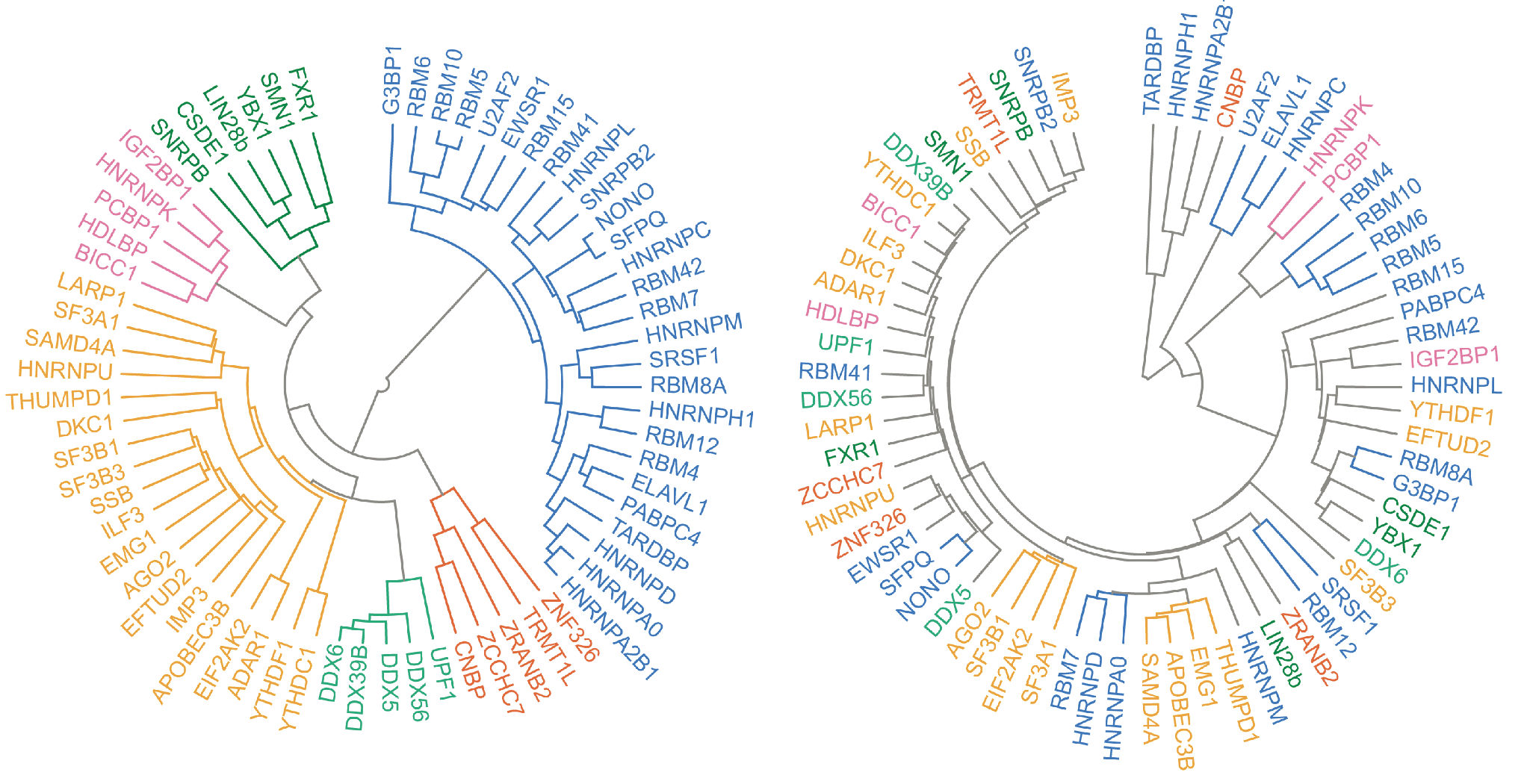
RNA-binding proteins (RBPs) guide nearly every step of an RNA molecule's life. From the moment a gene is transcribed, they help determine how the transcript is spliced, where it travels in the cell, how often it is translated into protein, and when it is broken down. Humans have roughly 1,500 RBPs, accounting for about 7.5% of our protein-coding genes, and their malfunction has been linked to a range of diseases, including cancer.
Yet RBPs are notoriously difficult to study. They are sticky, and the RNAs they bind can vary wildly in number, from a few copies per cell to thousands, making it hard to tell which interactions matter. The go-to method for mapping where they bind, CLIP-seq, uses UV light to lock proteins onto the RNA they're touching, then pulls each protein out to read what it was bound to. It's precise, but it typically relies on a separate antibody for every protein, and data quality has varied with the antibodies available.
In pursuit of a more robust approach, researchers at Arc Institute, Biohub, UCSF, and the Vector Institute developed eclair-CLIP, a method that gives every RBP the same small tag, so each one can be pulled down in exactly the same way. It also replaces radioactive labeling with infrared detection. Using eclair-CLIP, the team built an atlas of 67 cancer-associated RBPs in human cells, mapping more than 9 million RNA binding sites at single-nucleotide resolution. Because every protein was processed the same way, differences in binding reflect biology rather than technical variation.
They then used the atlas to train Pythia, an AI model that captures both the sequence of RNA and the ways it can fold, and measures how much each property shapes RBP binding preferences. Through this analysis, they uncovered some RBPs that only care about RNA sequence, whereas others primarily recognize RNA partners by their shape. For this latter group, disrupting the structures Pythia identified weakened the RBPs’ grip on the RNA. Finally, collaborators at Calico incorporated the atlas into Borzuki, a genome-scale model of post-transcriptional regulation. Adding RNA-binding and related data improved Borzuki's predictions of gene expression and helped it outperform Calico's earlier model, Saluki, at identifying genetic variants in 3′ UTRs that affect how much of a gene is expressed.
The work is posted today on bioRxiv.
In this conversation, two of the lead scientists discuss how a coffee chat led to a new atlas, why RNA-binding proteins have been so hard to pin down, and why they think this corner of biology is overdue for more attention:
- Hani Goodarzi (X: @genophoria) is a Core Investigator at Arc Institute and a Professor at the University of California, San Francisco. His lab focuses on computational cancer biology and RNA biology.
- Manuel Leonetti (X: @LeonettiManuel) is the Senior Director of Systems Biology at Biohub.
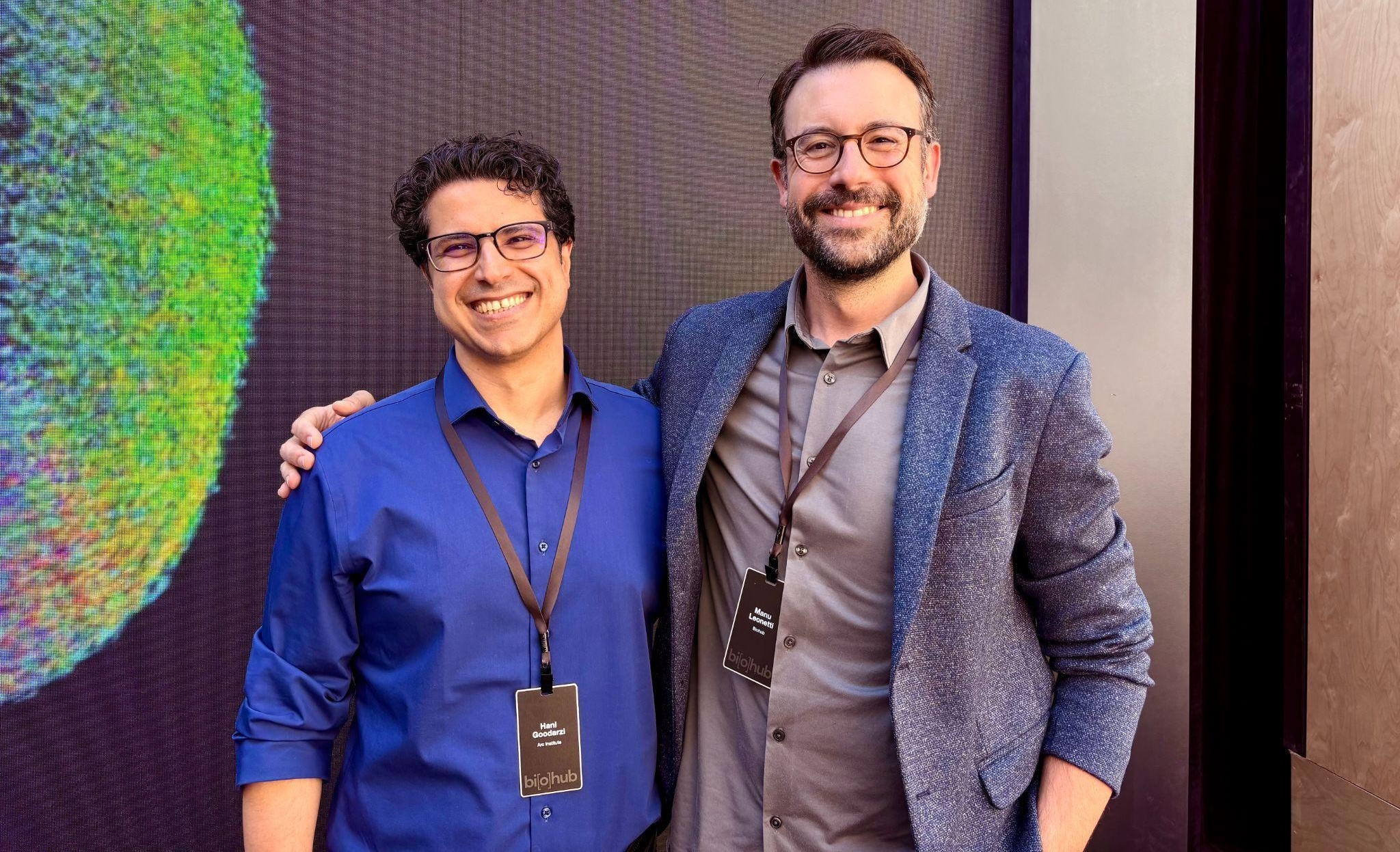
What sparked this collaboration?
Manuel Leonetti: It started a little serendipitously. Years back, when Hani was a Biohub Investigator, I had just presented part of our work at a Biohub Investigator meeting, and we got coffee right after. It was immediately clear that between what he was doing and what I was doing, there was something really synergistic.
Hani Goodarzi: One of Manu's big projects was OpenCell, where his team was endogenously tagging proteins across the proteome, then using imaging to see where each one sits in the cell and mass spec to see which other proteins it was interacting with. It was, and still is, a huge resource for the community. He showed early results where the RNA-binding proteins formed their own distinct functional clusters based on their interactome and localization. The RBPs were clearly doing their own thing. My lab is an RNA biology lab, and I've worked on RNA-binding proteins for a long time, so that caught my attention.
How have methods for mapping where RBPs bind evolved over time?
Hani Goodarzi: CLIP was first developed in Bob Darnell's lab at Rockefeller, before the sequencing era. It was a multi-day if not multi-week protocol and involved radioactivity, but it was so clean you could clone out what came from the process and identify real binding sites. When next-generation sequencing arrived, it became HITS-CLIP, or CLIP-seq, and the cross-linking event itself showed up as a mutation in the sequencing reads, so you knew exactly where the protein was sitting. I was lucky to learn it directly as a postdoc at Rockefeller in Sohail Tavazoie’s lab, collaborating with the Darnell group, but it was a grueling process that folks often struggled with.
When the ENCODE project set out to scale CLIP to hundreds of proteins, Gene Yeo's lab developed enhanced CLIP, or eCLIP. It worked well, but the quality varied between the profiled RNA-binding proteins, and much of that comes down to whether a good antibody exists for a given protein. Good antibody, clean data. Poor antibody, not so much.
What led you to eclair-CLIP?
Hani Goodarzi: In our lab, we had been developing a more accessible and efficient version of CLIP called eclair-CLIP. It got rid of the radioactivity by using infrared labeling instead, but we were still using the same antibodies as everyone else, and we still saw a lot of variation in data quality.
What excited me about Manuel's approach was that every protein carried the same tag endogenously, without the need for trans-gene over-expression. That means every protein goes through exactly the same immuno-precipitation, so you can use stringent washes and you don't get variation from using a different antibody each time. The data are normalized by design. The trade-off is that you're adding a tag to the protein, which could have some effect, but the upside seemed far greater.
Manuel was generous enough to share a batch of RBPs his team had already tagged and validated. Dr. Lisa Fish, the postdoc in my lab who developed eclair-CLIP, ran them, and the data were incredibly clean. It was one of those pilot experiments that actually worked quite well, and it motivated us to go further. We went back to Manuel’s team, they helped us tag another 30 or so RNA-binding proteins, and the rest is history.
Why use eclair-CLIP to build an atlas?
Manuel Leonetti: Hani and I have both been really interested in the power of atlases, and in mapping the networks of interactions between cellular components. We started by asking how proteins interact with each other, but the cell is much more than proteins working together, and we didn't have the tools to map protein-RNA interactions at scale.
A huge unlocking factor in building atlases like this is simplifying and standardizing the experiments. You want the simplest protocols that can drive the entire pipeline. For us, that meant realizing we could tag cell lines, select them, and run CLIP on them in a completely uniform way. That combination of tools, optimized for scale, simplicity, and robustness, is what made this powerful.
The reason we keep building atlases is that they're useful both for learning biology and for training models. What Hani and his collaborators did was take the experiments we started together, build a critical mass of data that's harmonized, clean, and interpretable, and use it as a foundation to train models that answer far more questions than we expected when we started.
How does David Kelley's team at Calico fit into this project?
Hani Goodarzi: We wanted to bring an applied perspective to the paper. If we had built a resource that is genuinely useful for understanding RNA regulation, the best test was to see whether it actually helped model RNA regulation. David Kelley's team is very well known in this space. They had built Borzoi, a widely used genome-track model, and Saluki, which models RNA stability, a key part of post-transcriptional regulation. They were combining the two into Borzuki, and I shared our data with them early on. If a group of that caliber is building a model of post-transcriptional control and our data make that model better, that's a real demonstration of value. They saw that training Borzuki with RNA-binding data improved its predictions of gene expression, and it outperformed their earlier model, Saluki, at picking out genetic variants that change how much of a gene is expressed.
We’ve known that RNA structure can matter for binding. What does Pythia add?
Hani Goodarzi: There's long-standing knowledge in the field that both sequence and structure matter for RNA function. It isn't pure sequence, like DNA, and it isn't purely structural, the way we tend to think of proteins. But even across different RNAs, some molecules are highly structured and for others structure matters less.
This question goes back to my time as a graduate student. I have papers from 2012 where we built some of the first machine learning tools in genomics to ask what the structural determinants of RNA regulation are and how to capture them. Pythia is the culmination of those efforts, bringing that way of thinking into state-of-the-art modeling. The big claim is that it can decode structural contributions that existing models usually miss. And, more importantly, it's interpretable. It can tell you which binding sites are actually driven by structure.
What does it take to pull a project like this together?
Manuel Leonetti: There are a couple of layers. Building a resource is itself a catalyst for collaboration: you put it out there and invest in making it as open and accessible as possible. Then there's the more tangible, lab-to-lab kind of collaboration. My advice is to be generous. Share your ideas, present your unpublished work, and don't be afraid to run pilots. If something makes sense, find the smartest, smallest pilot that will tell you whether the idea has legs. That's what we did. It was easy to get people motivated because the value was clear if it worked, and the pilot wasn't going to take forever to give us an answer.
Hani Goodarzi: We were also privileged to be in a setting built for exactly this. The Biohub investigator program put real structure around getting people together in person, having lunch, and interacting, and we were strongly encouraged to show unpublished work. It worked. This was one of several collaborations that came out of that environment for my lab. And it was really fun to work on this together.
What's the field been missing about RNA-binding proteins?
Manuel Leonetti: As a cell biologist, I think protein-RNA interactions are understudied, and we probably underestimate their importance, both in how RNA binding shapes protein function and in how proteins shape RNA. In this work and in OpenCell, we keep finding results that point to the functional importance of that crosstalk. We're looking at the tip of the iceberg.
As Hani mentioned, one of the big findings from OpenCell was that RNA-binding proteins form their own distinct clusters in terms of localization or protein-protein interactions. We now think it is linked to protein disorder and condensate formation. And across evolution, one of the major differences between the yeast and human proteomes is the sheer number of RNA-binding proteins. That tells you they're adding new function and plasticity, and there's a lot of work, for example, on their importance to neurons and to the evolution of the brain.
Hani Goodarzi: Part of it is that the RNA field has been smaller than genomics more broadly, and much of the attention has gone to DNA and the epigenome. When I was a graduate student, post-transcriptional control was still fairly new, and many people moving into it brought parallels from the DNA world, treating RBPs as the equivalent of transcription factors and RNA as similar to DNA. That had real benefits. We could hit the ground running with tools built for DNA, and I did some of that early work myself.
But these are very different families of proteins with very different modes of interaction. RNA-binding proteins shepherd RNA from transcription all the way through translation and decay. Every one of those steps is heavily regulated, and there's human disease at every one of them. There's more to gene expression than steady-state levels measured by RNA-seq, and there's still a lot of work to do in bringing new tools to understand what that layer of regulation is doing.
What comes next, and how can others get involved?
Manuel Leonetti: We looked at 67 RNA-binding proteins, but there are well over a thousand in the human proteome. We think this first atlas shows the value of the approach, though it took a lot of work from many talented people. We hope it motivates others to help us keep building. We'd also like to put this work in the context of everything else OpenCell has mapped, for example by adding RNA-binding data to the OpenCell website.
For anyone looking to try this themselves, these tools are easier to use than people might think, and they're very powerful. We're here to help share protocols, reagents, and know-how, so please reach out if you're excited about applying them to your research! We'd love to help.
###
Karimzadeh, M., Fish, L., Karner, H., Linder, J., Emadi, A., Hernandez-Corchado, A., Smaili, F. Z., Stewart, E. M., Kelley, D. R., Wang, B., Najafabadi, H. S., Leonetti, M., & Goodarzi, H. (2026). A high-resolution RNA-protein binding atlas for structure-aware interaction prediction and post-transcriptional regulatory modeling. bioRxiv. https://doi.org/10.64898/2026.10.12.758580