
Bolero: a cell-state conditioned sequence model for context-specific gene regulation
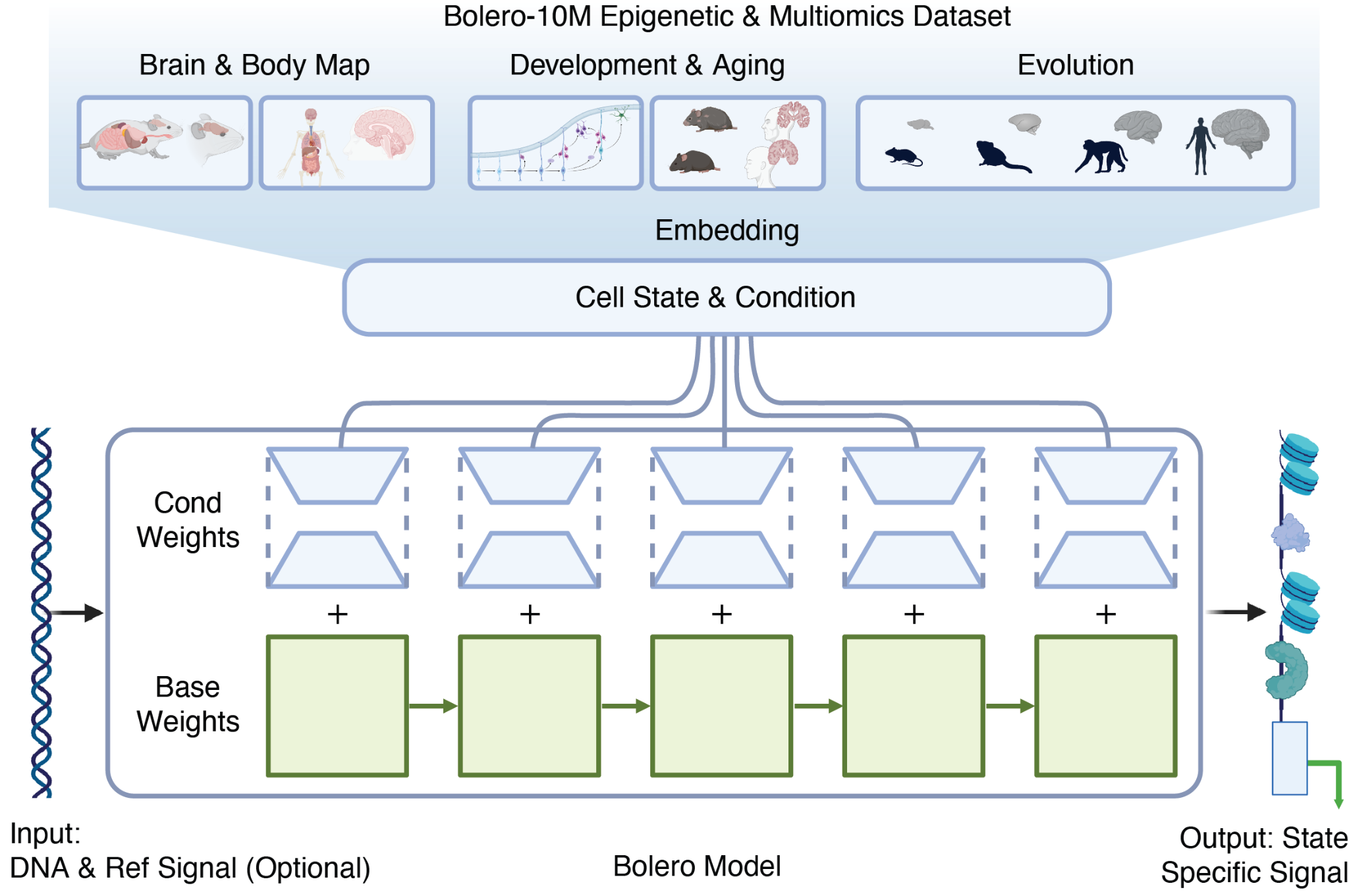
If cell state is a song, our DNA is the sheet music, but the epigenome is the orchestra. DNA provides the same basic sequence, but how different cell types use that sequence depends on which transcription factors are present and the level of chromatin accessibility. Have you ever heard Ravel’s Boléro? In that piece, each instrument riffs off the same musical theme to create variety in a massive musical crescendo. The intricate processes modifying gene expression are akin to this, and Ravel’s playful orchestral experiment is the namesake for our new cell-state predictive model, Bolero, posted today on bioRxiv.
How Bolero Works
When generating Bolero, we had two main questions: how do we build better models for predicting the effects of cell-type-specific mutations, and can we use a cell’s regulatory grammar to predict how they respond to a perturbation? With Bolero, we answer both. To predict expression based on cell type, Bolero takes two distinct inputs: the raw DNA sequence and a “cell-state embedding”, a mathematical representation of a cell's identity derived from a massive 10.8-million-cell atlas that includes single-cell epigenome and multiomics data from a broad range of cell types, representing different tissues, developmental stages and ages, and evolutionary divergence in six mammals, including humans.
By conditioning the sequence model on this cellular context, Bolero successfully predicts cell-state-specific transcript abundance and chromatin accessibility directly from DNA alone. But Bolero doesn't just append the cell identity as a tag at the end of the process. Instead, it can literally alter its own neural network architecture based on the cell type you query. When you input a specific cell-state embedding into Bolero, the model generates unique, custom weights that are mathematically added to the model's baseline Transformer network at every single layer. Because these custom weights are generated dynamically for each specific cell type, every cell state gets its own effective network. In practice, this enables scientists to ask what a given sequence would do in a cell state that hasn’t been profiled yet, without running a wet lab experiment first.
Using Bolero to Decode the Regulatory Logic of Specific Cell States
An illustrative use case of Bolero is our work in collaboration with Michael Greenberg's lab at Harvard Medical School. We wanted to understand how rapid expression of immediate early genes, in this case AP-1 transcription factors, induced downstream responses in a cell-type-specific manner. To do this, we used the sequence model to understand where cell-type specificity is coming from, conditioning the model not only on cell state but also on transcription factor activity. In essence, we added a volume dial for neural activity (the AP-1 signal) into the Bolero model to help us understand how vastly different brain cells interpret the exact same stimulation. And, turning this dial up in a virtual simulation, Bolero accurately predicted the unique ways that specific cells, like two types of hippocampal neurons, would change their DNA accessibility in response to that shared signal.
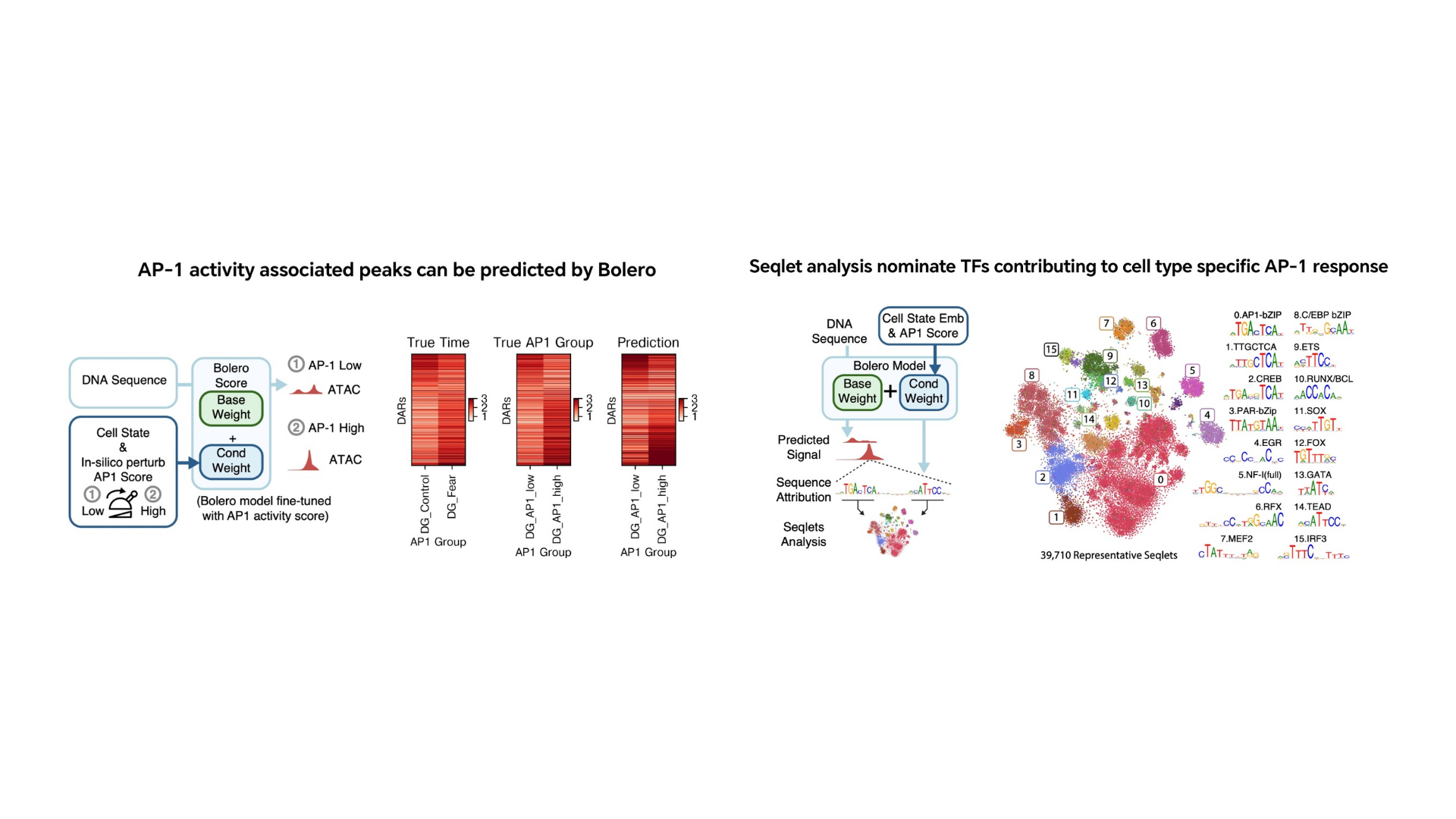
But accurate predictions are just one feature of Bolero among many. Asking the model why it made those predictions revealed another hidden feature of the genome's grammar: different transcription factors teamed up with AP-1 depending on cell class. Not only that, but the physical distance of those co-factors relative to AP-1 mattered. By running virtual DNA-editing experiments (in silico insertions), we discovered that placing the cooperative factor FOX exactly 4 base pairs away from AP-1 acts as a secret syntax rule to dramatically boost a cell's response in epithelial cells across the human body. Bolero went from just reading DNA to simulating a cell's reaction to neuronal activity and successfully reverse-engineering the exact physical code the cell used to trigger that reaction.
A central challenge in translational biology is that many experiments can only be run in model organisms, leaving open whether the same rules apply in the human brain. In the AP-1 experiments, Bolero generated predictions that were generalizable across species, even when those species weren’t included in training data. When we trained Bolero's AP-1 activity model using only human data, and then asked this human-trained model to predict AP-1 activity based on raw mouse and macaque DNA, Bolero hit it out of the park. The model correctly predicted which enhancers would switch on in response to the same neural-activity signal in mouse and macaque neurons, despite never having seen a single cell from either species during training. This suggests that Bolero isn't just memorizing where AP-1 motifs sit in the human genome; it has actually learned how cells interpret that signal well enough to read it out of an entirely different species' DNA. While our behavioral experiments could only be carried out in model organisms, Bolero’s demonstrated ability to transfer correctly across species means we can begin to interpret unique changes in the human activity-dependent genome, even without direct mapping from behavior to gene readouts.
The model can also score disease-linked variants from human genetics studies and, in some cases, it can even design new enhancers from scratch, editing a handful of bases to redirect a synthetic sequence toward a chosen cell type and activity state.
Across our bodies, epigenomic elements are composing unique phrases, interpreting the leitmotif of our DNA sequences to generate the different cell states that make up our heart, our lungs, our brain. These elements exist across species, connecting the rules of gene expression in human cells to those in mice and other model organisms. Bolero learns from each of those pieces to teach us more about the molecular drivers underlying cell state.
Liu, H., Mao, S., Gallent, T., Chen, Y., Yan, Z., Vogel, I., Traunmüller, L., Zhang, R., Buenrostro, J.D., Zhou, J., & Greenberg, M.E. Predicting state-specific regulation across cellular contexts and species with Bolero. bioRxiv (2026). https://doi.org/10.64898/2026.10.19.760026
Jingtian Zhou (X: @zhou_jingtian) is an Arc Institute Science Fellow